In modern learning environments, content is growing faster than teams can organize it. Traditional search bars inside Learning Management Systems (LMS) are no longer enough. They only scan titles, tags, or metadata, which means learners often miss the information they need, even when it exists in the system. This is where Deep Search becomes a transformational feature.
Deep Search helps L&D teams surface hidden knowledge, personalize learning, and deliver training that moves at the speed of business. In this guide, we break down what deep search is, how it works, and how Learning & Development teams can leverage it to improve training outcomes.
What Is Deep Search in an LMS?
Deep Search is an AI-powered search capability that scans beyond file names, titles, and manual tags. Instead, it understands the actual meaning inside documents, videos, transcripts, SCORM packages, assessments, slide decks, and even conversations. This makes it dramatically more accurate than traditional keyword search.
Rather than relying on exact matches, deep search interprets the context of what the learner is looking for. It can locate concepts, topics, skills, and insights buried deep within any learning asset. For organizations with massive content libraries, it turns hidden learning into instantly accessible knowledge.
How Deep Search Works
Deep search uses advanced natural language processing (NLP), semantic understanding, and vector-based indexing. Instead of matching words letter by letter, it maps content and queries into multidimensional vectors. This allows the system to understand meaning, relationships, and intent.
The LMS breaks down every learning asset into concepts, entities, skills, and topics. These are then stored in a searchable knowledge graph. When a learner searches, the LMS scans this entire graph, instantly surfacing answers that traditional search would overlook. As the content library grows, the search engine becomes smarter.
How to Apply Deep Search to an LMS
Integrating deep search requires both AI-driven indexing and structured data management. First, the LMS must analyze existing content and convert it into machine-readable meaning. Second, it must build links between different topics and training materials. Finally, the search experience should be simple enough for users to instantly find what they need.
Organizations should also align deep search with skill frameworks, learning paths, and personalization models. This ensures the search engine not only retrieves information but also connects learners with the resources relevant to their role or goals.
Example of a Deep Search Workflow
Imagine an employee searching for “how to handle enterprise objections” in a sales training LMS. Traditional search would show only courses with the exact phrase in the title or description. Deep search, however, scans across multiple formats and sources.
It retrieves video segments discussing objection handling, slides about enterprise sales challenges, quiz questions on negotiating, and documents covering buyer psychology. It might even highlight a 45-second clip buried inside a 30-minute video. This precision ensures faster discovery, better knowledge access, and a smoother learner experience.
Guide for L&D Teams: Making the Most of Deep Search
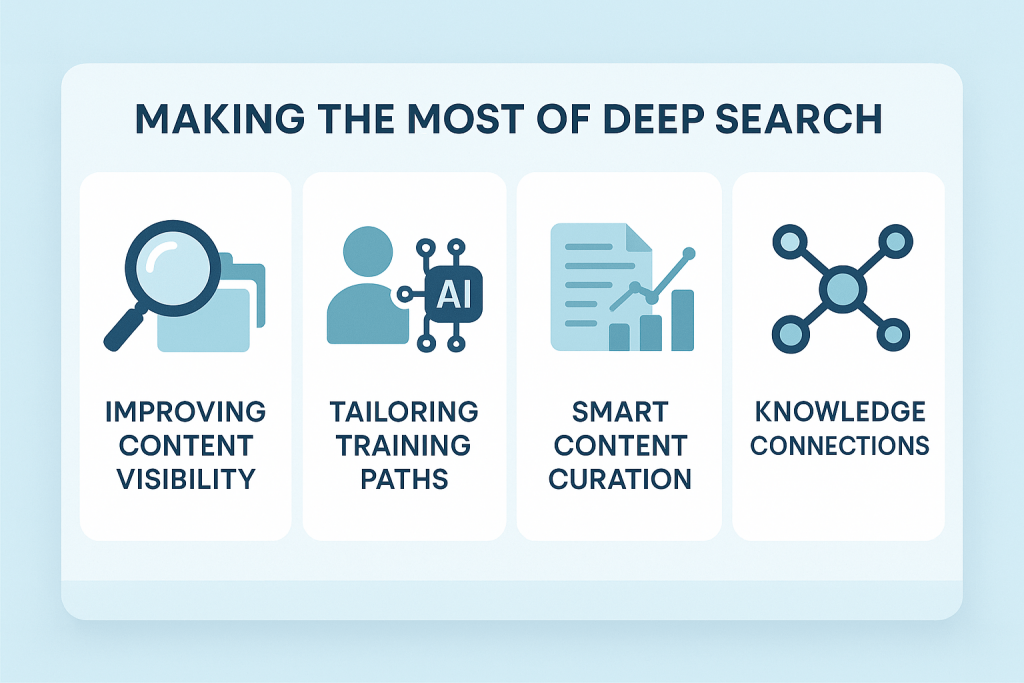
Deep search has implications far beyond convenience. It reshapes how Learning and Development teams design, deliver, and evaluate learning experiences. When used effectively, it reduces repetitive content creation, improves retention, and boosts overall training efficiency.
Below are practical ways L&D teams can maximize the value of deep search inside their LMS, especially in large organizations with fast-changing knowledge environments.
1. Improving Content Visibility and Streamlined Learner Navigation
With deep search, learners no longer waste time navigating folders, catalogs, and long course lists. Instead, the search engine delivers precise answers instantly. This drastically enhances the learner experience and improves engagement metrics across the LMS.
L&D teams can use deep search analytics to understand what people are searching for, and whether content gaps exist. When the search engine becomes a gateway to knowledge rather than a dead end, users feel more confident and satisfied with the platform.
2. Tailoring Training Paths Through Intelligent Search Insights
Deep search doesn’t just retrieve information, it understands what the learner’s query means. This semantic understanding supports personalized recommendations. The LMS can analyze learner behavior, past searches, job role, and skill gaps to suggest the right learning assets.
Instead of browsing through generic courses, learners receive targeted content tailored to their needs. This accelerates completion rates, supports self-directed learning, and helps organizations deliver individualized training at scale.
3. Strengthening Learning Content Planning and Smart Curation
By analyzing search patterns and discovery behavior, L&D teams can quickly understand which topics employees struggle with. Deep search highlights underused, outdated, or hard-to-find content. It also identifies areas where multiple teams are searching but no relevant material exists.
This transforms content strategy. Rather than creating content blindly, L&D teams can produce material driven by real demand. They can also reorganize existing content for better accessibility, maximizing the value of every learning asset in the library.
4. Building Better Knowledge Connections Across the Organization
Deep search automatically builds semantic relationships between documents, videos, and courses. This makes it easier to create a living knowledge map, a constantly updating representation of how information flows across the organization.
For L&D teams, this means better visibility into skill distribution, topic clusters, and learning prerequisites. Knowledge maps help in creating stronger learning paths, advanced role-based training programs, and performance-based skill development models.
Actionable Steps to Integrate Deep Search in Your LMS
Implementing deep search doesn’t have to be complicated. With the right plan, it can dramatically improve the utility and intelligence of an LMS. Below are clear steps for deploying and optimizing deep search in your learning ecosystem:
1. Assess Your Existing Content Library
Start by auditing all learning assets, videos, documents, SCORM files, PDFs, slides, assessments, SOPs, and guides. This helps identify structure issues and gaps that deep search can help illuminate.
2. Integrate an AI-Powered Search Engine
Choose an LMS or plugin that supports semantic indexing, natural language processing, and vector search. Ensure it can analyze multiple content formats without manual tagging.
3. Align Deep Search With Skill Frameworks
Map search results to organizational skills, job roles, and competencies. This ensures every search helps employees move closer to role mastery.
4. Set Up Analytics and Search Insights
Monitor what learners are searching for. Use these insights to develop new training content, fix outdated materials, or simplify navigation.
5. Provide Training for Admins and Teams
L&D admins should understand how to manage indexing, interpret analytics, and build structured content models. This empowers teams to fully leverage deep search capabilities.
6. Continuously Refine and Expand
As your content grows, deep search grows with it. Keep updating content formats, adding metadata, and refining skills mapping for the best results.
Deep Search Is the Future of Intelligent Learning
As training content becomes more complex, deep search is no longer a luxury, it’s a necessity. It ensures employees can quickly access the exact knowledge they need, at the moment they need it. For L&D teams, it provides unmatched insights into content performance, learner intent, and skill gaps.
AI-powered deep search transforms an LMS into a dynamic knowledge engine, supporting modular learning, adaptive training, and continuous skill development. Organizations that adopt it early will gain a major advantage in workforce capability and learning effectiveness.
