Thought Industries and Beetsol both position themselves as customer training platforms for B2B SaaS companies. But they take fundamentally different approaches to solving the same dual-threat problem: How do you accelerate deep product adoption while simultaneously deflecting the support tickets that overwhelm your team during high-growth phases?
While Thought Industries is a mature, feature-rich platform built to manage structured, high-touch learning programs, Beetsol is an AI-native, search-first platform built to drive instant feature discovery. The difference isn’t just a list of features — it’s an architectural philosophy on whether learning should be a destination or a seamless layer of the product experience.
This comparison examines both platforms across pricing, features, implementation, ideal customer fit, and real-world use cases to help you decide which approach matches how your customers actually learn. For broader context on modern customer training strategies, see our complete customer training LMS guide.
Thought Industries: Overview
Thought Industries was founded in 2013 as an external learning platform focused on customer, partner, and professional education, with strong support for monetizing training programs. The company targets mid-market to enterprise B2B companies that need customizable, branded learning experiences.
What Thought Industries Does Well
1. Flexible Content Delivery
Thought Industries offers multiple content formats: video, SCORM, xAPI, documents, live sessions, and third-party integrations. Content can be delivered as courses, learning paths, or standalone resources.
The platform’s flexibility means you can structure learning in various ways depending on audience needs.
2. Strong API and Integrations
Thought Industries provides a robust REST API that allows deep customization and integration with CRM, marketing automation, and business intelligence tools.
For companies with engineering resources, this enables custom workflows and data synchronization across systems.
3. Revenue-Generating Capabilities
Unlike most LMS platforms, Thought Industries includes native e-commerce functionality. Companies can sell courses, certifications, and subscriptions directly through the platform.
This matters for businesses that monetize training (partner certification programs, paid customer academies).
4. White-Label Customization
Thought Industries allows extensive branding customization. Customer academies can match corporate identity precisely, maintaining brand consistency throughout the learning experience.
Where Thought Industries Falls Short
1. Still Fundamentally Course-Based
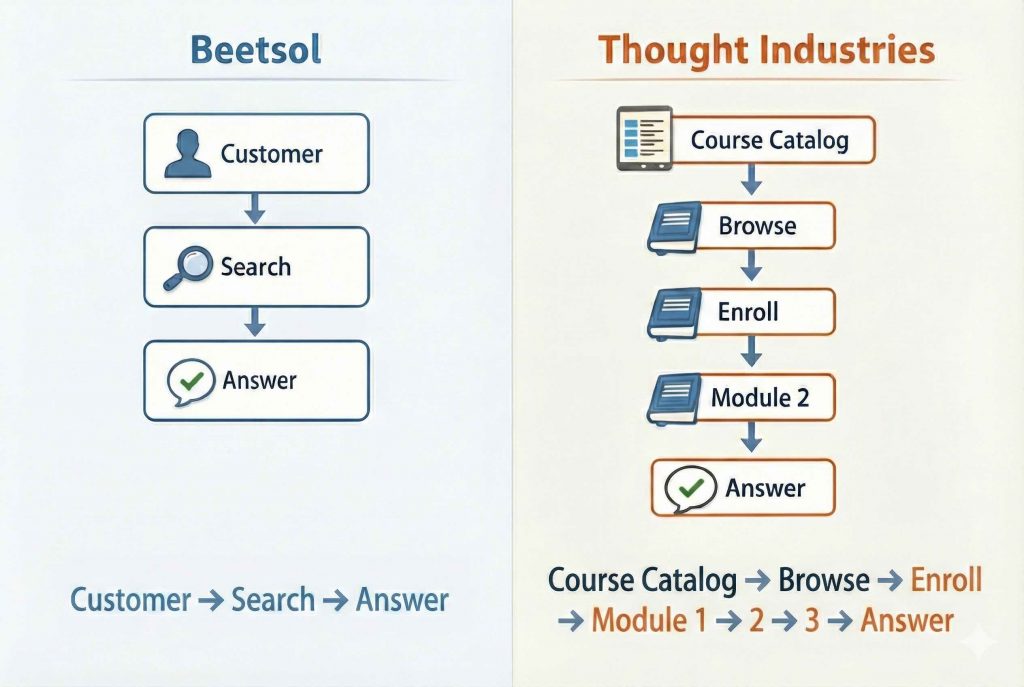
Despite offering flexible content delivery, Thought Industries organizes learning around courses and learning paths. Customers must navigate structured programs to find specific answers.
When a customer needs one answer right now, they don’t want to browse course catalogs or enroll in multi-module programs.
2. Search Remains Secondary
Thought Industries includes search functionality, but it’s keyword-based and treats search as a navigation aid, not the primary interface.
Customers searching “how do I reset permissions” might find courses titled “User Management Fundamentals” but miss the specific 2-minute answer buried in Module 3.
3. Complex Implementation
Thought Industries implementations typically take 2-4 months for mid-market companies. The platform’s flexibility comes with configuration complexity.
Teams need to structure content, configure workflows, build integrations, and customize branding before launch.
4. Pricing Complexity
Thought Industries uses quote-based pricing with significant variation based on learner volume, features, and contract terms. Mid-market companies typically pay $25,000-$40,000 annually, but pricing isn’t transparent.
5. Over-Engineering for Many Use Cases
Thought Industries offers extensive features: cohort management, advanced analytics, learning commerce, certification tracking, and more. For companies that simply need customers to find training quickly, this complexity exceeds requirements.
Beetsol: Overview
Beetsol launched in 2025 as a search-first learning platform specifically for B2B SaaS customer training. The platform is built on the premise that customers search before they browse, and training should adapt to this reality.
How Beetsol Works Differently
1. Search-First Architecture
Beetsol treats search as the primary interface, not a secondary feature. Content is organized for instant discovery, not sequential consumption.
Upload existing videos, PDFs, SCORM files, and documents. Beetsol uses vector embeddings (pgvector) to understand the meaning of customer questions, not just keywords.
Example:
- Customer searches: “how do I add a team member”
- Thought Industries finds: Courses with those keywords (often irrelevant)
- Beetsol finds: “User Permissions,” “Invite Colleagues,” “Role Management” (conceptually related)
Customers can follow structured learning paths if they want guidance, but they’re never forced into courses to access specific information.
This flexibility ensures that while the ‘Quick-Fix’ user gets an answer in 30 seconds, the ‘Power User’ has the structured path they need to master the platform — directly impacting long-term Net Revenue Retention (NRR).
2. Intent Resolution Over Completion
Beetsol measures whether customers found their answer (intent resolution) in addition to whether they completed courses.
The platform tracks:
- What customers search for but can’t find (content gaps)
- Where customers exit without resolution (friction points)
- Which content correlates with feature adoption (what actually works)
These insights reveal where training fails, not just how many people finished Module 3.
3. Embedded Learning
Beetsol embeds directly into products, help centers, or support workflows. Customers get answers without leaving what they’re doing.
No separate academy login. No context-switching. Training happens where customers already work.
4. Days to Launch, Not Months
Beetsol implementations take 1-3 days, not 2-4 months. Upload content, configure search, embed in your product, and launch.
No extensive restructuring. No complex workflows. No multi-month professional services engagement.
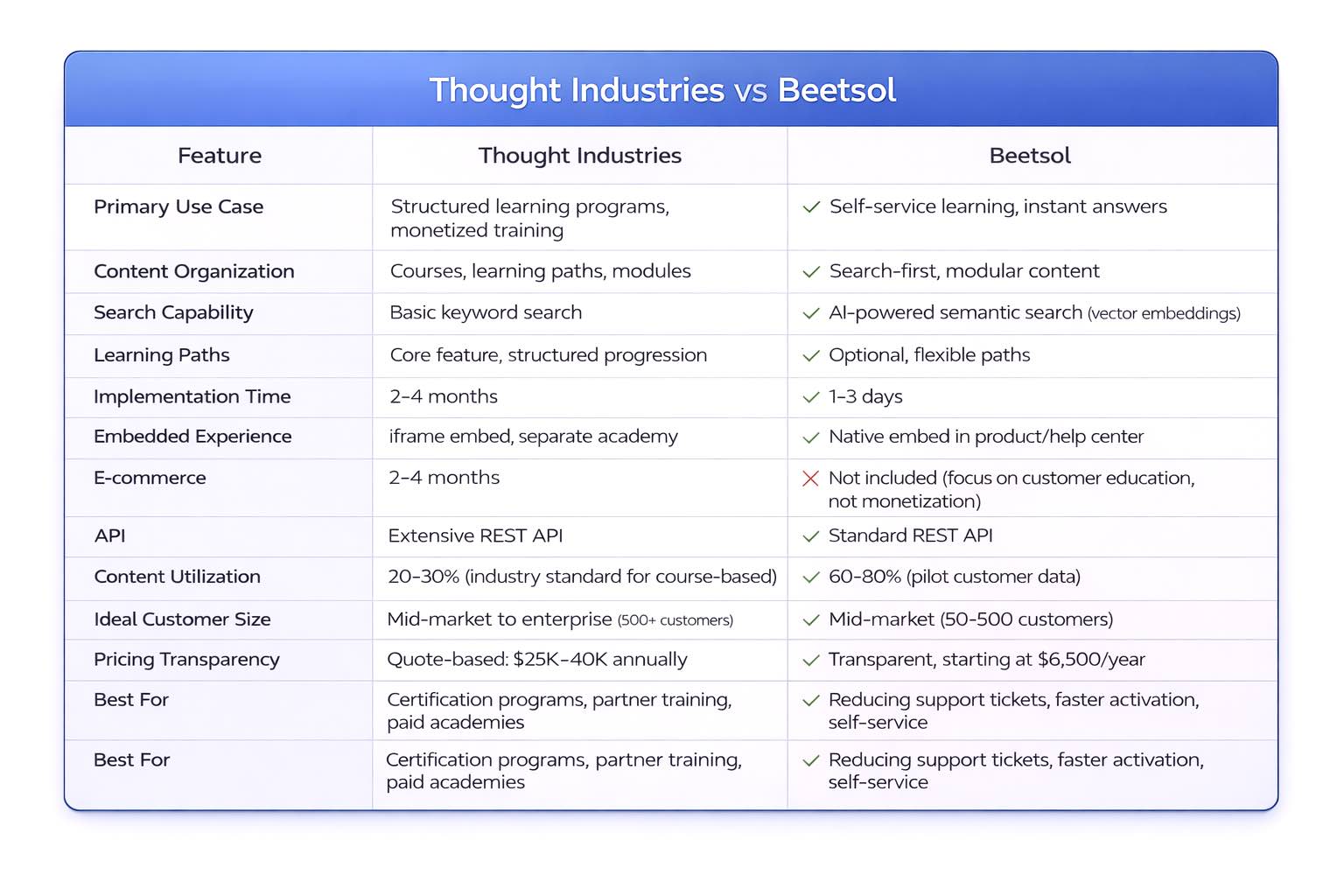
Feature-by-Feature Comparison
| Feature | Thought Industries | Beetsol |
|---|---|---|
| Primary Use Case | Structured learning programs, monetized training | Self-service learning, instant answers |
| Content Organization | Courses, learning paths, modules | Search-first, modular content |
| Search Capability | Basic keyword search | AI-powered semantic search (vector embeddings) |
| Learning Paths | Core feature, structured progression | Optional, flexible paths |
| Implementation Time | 2-4 months | 1-3 days |
| Embedded Experience | iFrame embed, separate academy | Native embed in product/help center |
| E-commerce | Native payment processing, subscriptions | Not included (focus on customer education, not monetization) |
| API | Extensive REST API | Standard REST API |
| Content Utilization | 20-30% (industry standard for course-based) | 60-80% (pilot customer data) |
| Ideal Customer Size | Mid-market to enterprise (500+ customers) | Mid-market (50-500 customers) |
| Pricing Transparency | Quote-based, $25K-40K annually | Transparent, starting at $6,500/year |
| Best For | Certification programs, partner training, paid academies | Reducing support tickets, faster activation, self-service |
Pricing Comparison
Thought Industries Pricing
- Not publicly listed
- Quote-based model
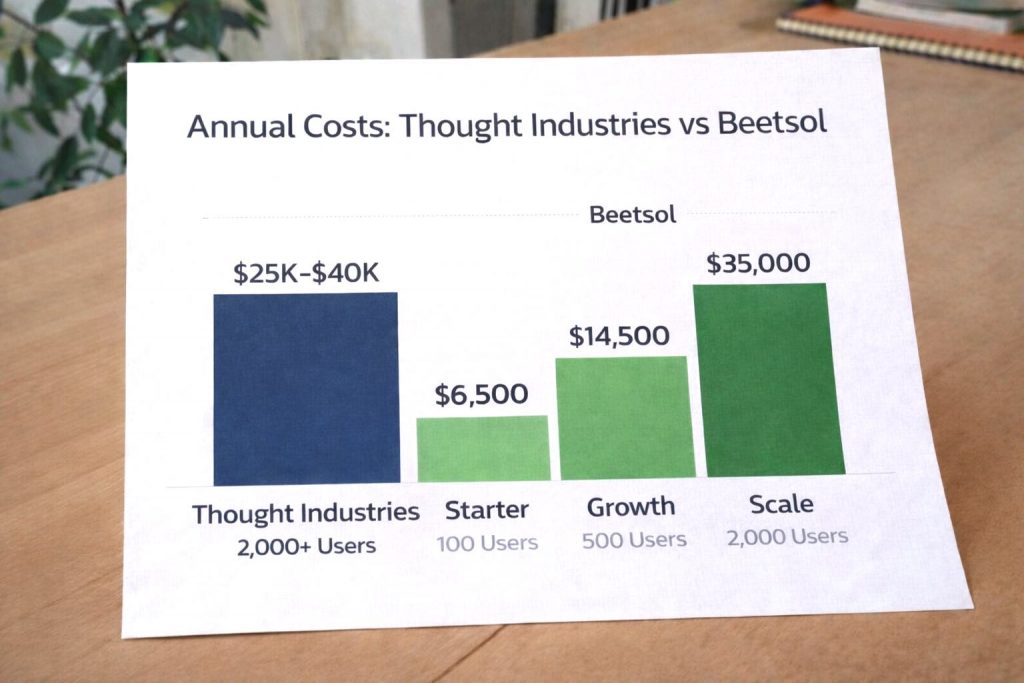
- Typical range: $25,000-$40,000+ annually for mid-market
- Pricing varies by learner volume, feature set, integrations
- Additional costs for professional services, custom development
- Long-term contracts (typically 1-2 years)
Beetsol Pricing
- Transparent, published pricing
- Starter: $6,500/year (up to 100 active learners)
- Growth: $14,500/year (up to 500 active learners)
- Scale: $35,000/year (up to 2,000 active learners)
- Implementation included, no professional services fees
- Month-to-month or annual contracts
View complete Beetsol pricing details →
Cost difference: A 200-customer company pays $14,500/year with Beetsol vs $30,000-35,000/year with Thought Industries — a 50-60% savings while gaining faster implementation and higher content utilization.
Calculate Your Own ROI
Use Beetsol’s ROI calculator to estimate your actual savings based on your support ticket volume, customer count, and current LMS costs.
Calculate your potential savings →
The calculator accounts for:
- Support ticket deflection (typically 20-35% reduction based on industry data)
- Faster customer onboarding (15-30% time reduction)
- Current LMS costs eliminated
- Net implementation costs
Most mid-market SaaS companies see payback in 3-6 months when factoring in support cost savings alone.
Implementation Timeline Comparison
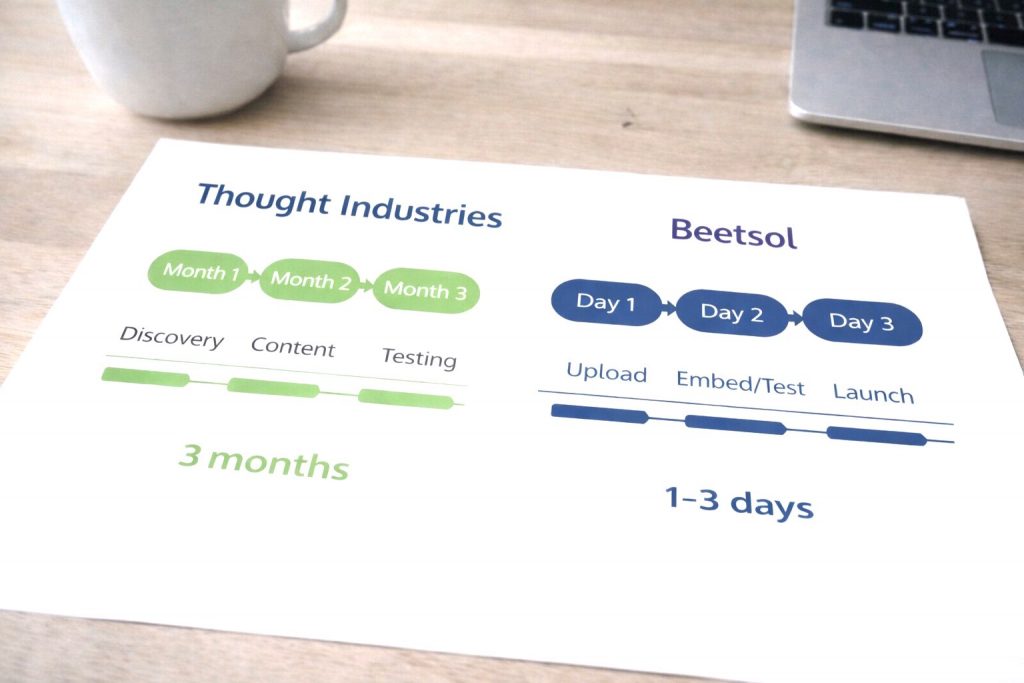
Thought Industries Implementation
Month 1:
- Discovery calls and requirements gathering
- Content audit and migration planning
- Platform configuration setup
Month 2:
- Content restructuring into courses
- Integration configuration
- Custom branding development
Month 3:
- API integrations and testing
- Admin training
- Soft launch preparation
Month 4:
- Full rollout
- Optimization begins
Total: 3-4 months to go-live
Beetsol Implementation
Day 1:
- Upload existing content (videos, docs, PDFs)
- AI auto-indexes and makes searchable
- Configure basic settings
Day 2:
- Embed in product or help center
- Test search functionality
- Customize branding
Day 3:
- Launch to customers
- Begin tracking usage and intent resolution
Total: 1-3 days to go-live
The difference: 90-120 days vs 1-3 days. That’s 3-4 months where customers are already getting value instead of waiting for implementation to complete.
Ideal Customer Fit
Choose Thought Industries When:
1. You Need Certification Programs That Generate Revenue
If you’re building paid academies, partner certification programs, or training-as-a-product offerings, Thought Industries’ native e-commerce capabilities matter.
Example: A software company charging $500 per partner certification course.
2. You Serve Enterprise Customers With Complex Hierarchies
Large enterprise customers often need role-based access, department-specific content, and approval workflows.
Thought Industries handles these scenarios well with cohort management and advanced permissions.
3. You Have Engineering Resources for Custom Integration
Thought Industries’ API enables deep customization. If you have developers who can build custom workflows, reporting dashboards, or unique integrations, the platform’s flexibility becomes valuable.
4. You Need Extensive Compliance Tracking
Industries with strict compliance requirements (healthcare, finance, manufacturing) benefit from Thought Industries’ detailed completion tracking, certification management, and audit trails.
Choose Beetsol When:
1. You Need to Reduce Support Tickets
If 40%+ of your support tickets are “how do I” questions about documented features, you have a discoverability problem, not a content problem.
Beetsol’s search-first architecture reduces tickets by making answers instantly findable. One pilot customer saw support tickets about trained topics drop 35% within 60 days.
2. You Want Faster Customer Activation
Time-to-value is critical for retention. Customers who reach their first success quickly are far more likely to remain customers after 90 days.
Beetsol accelerates activation by removing friction between questions and answers. No course enrollment. No prerequisites. Direct access to relevant information.
3. You Need to Launch Quickly
If you can’t wait 3-4 months for implementation, Beetsol’s 1-3 day launch timeline changes the equation.
You can be delivering value to customers this week instead of next quarter.
4. Your Customers Are Self-Directed
B2B SaaS customers are typically impatient, technical, and task-oriented. They don’t want guided learning experiences — they want answers to specific problems.
Beetsol respects this behavior by making search the primary interface.
5. You Want Embedded Learning
If training must happen inside your product workflow (not a separate academy), Beetsol’s native embedding works better than iframe embeds.
Context-switching kills engagement. Training that’s available exactly when needed converts better than training that requires navigation to another site.
Real-World Use Case Comparison
Use Case 1: Partner Certification Program
Scenario: A SaaS company needs to certify 500+ implementation partners on their platform before they can work with customers.
Better fit: Thought Industries
Why:
- Sequential learning path ensures partners complete all required training
- Certification tracking with expiration dates
- E-commerce allows charging for certifications
- Formal completion certificates partners can display
This use case requires structure, validation, and revenue generation — Thought Industries strengths.
Use Case 2: Customer Onboarding (30-Day Activation)
Scenario: A B2B SaaS company needs customers to reach first value within 30 days to reduce early churn.
Better fit: Beetsol
Why:
- Customers don’t need structured courses — they need answers to specific setup questions
- Search-first access means faster resolution when stuck
- Embedded learning surfaces help exactly when needed
- Intent resolution tracking shows where onboarding breaks
This use case prioritizes speed and self-service — Beetsol strengths. For more on effective customer onboarding strategies, see our 90-day customer onboarding blueprint.
Use Case 3: Feature Adoption Campaign
Scenario: A SaaS company launches advanced features but customers aren’t adopting them.
Better fit: Beetsol
Why:
- Customers need quick answers about new features, not full courses
- Search analytics reveal what features customers are asking about
- Modular content allows easy updates when features change
- Embedded training can surface where customers work
Use Case 4: Enterprise Customer Academy
Scenario: A company wants a branded academy with role-based learning for enterprise customers.
Better fit: Thought Industries
Why:
- White-label customization maintains brand consistency
- Role-based content (admin vs end-user tracks)
- Advanced reporting for enterprise customer success teams
- Structured programs align with enterprise expectations
Understanding “AI-Powered” in Both Platforms
Both Thought Industries and Beetsol mention AI capabilities. But the implementations differ significantly.
Thought Industries AI
Thought Industries offers AI-powered features including content recommendations, personalized learning paths, and automated tagging.
These features help optimize course delivery but don’t fundamentally change the course-based architecture.
Beetsol AI
Beetsol is AI-native: vector embeddings and semantic search power the platform from the ground up, not as bolt-on features.
This architectural difference means:
- Better intent understanding (finds answers customers need, not just keyword matches)
- Lower false positives (relevance threshold prevents irrelevant results)
- Search gap analytics (shows what customers look for but can’t find)
The question isn’t “Does it have AI?” but “Is AI solving the core problem?” For Thought Industries, AI enhances course delivery. For Beetsol, AI enables instant answer discovery.
Migration Considerations
Migrating FROM Thought Industries to Beetsol
If you’re considering switching from Thought Industries to Beetsol:
What transfers easily:
- All content (videos, documents, SCORM files)
- User lists and enrollments
- Basic analytics history
What requires rethinking:
- Course structure (content becomes modular, not sequential)
- E-commerce setup (if you monetize training, this needs alternative solution)
- Custom integrations (will need rebuilding)
Timeline: 1-2 weeks for content migration and testing, 2-4 weeks for full rollout
Migrating FROM Beetsol to Thought Industries
If you’re considering switching from Beetsol to Thought Industries:
What transfers easily:
- All content files
- User lists
What requires rebuilding:
- Content must be restructured into courses
- Learning paths must be designed
- Custom branding and configuration
Timeline: 2-4 months (standard Thought Industries implementation)
Common Decision Factors
Budget
If budget is tight and you’re a mid-market company (upto 500 customers), Beetsol’s pricing makes more sense.
If you’re enterprise-scale or monetizing training, Thought Industries’ pricing aligns better with the value delivered.
Timeline Urgency
If you need training live this month, Beetsol is your only realistic option.
If you have 4-6 months to properly implement and structure training, Thought Industries becomes viable.
Customer Learning Behavior
If your customers are highly self-directed and impatient (typical for B2B SaaS), search-first works better.
If your customers expect structured guidance or compliance mandates sequential learning, course-based works better.
Engineering Resources
If you have developers who can leverage Thought Industries’ API for custom workflows, that flexibility has value.
If you don’t have engineering bandwidth, Beetsol’s simpler implementation matters more.
What Customers Actually Say
Note: The following examples are based on pilot customer data and early implementation results. Individual results vary based on content quality, customer base, and implementation approach.
Thought Industries Customer Feedback
Common praise:
- “Flexible platform that adapts to our needs”
- “Strong API made custom integrations possible”
- “E-commerce features let us monetize partner training”
Common complaints:
- “Implementation took longer than expected”
- “Pricing increases significantly with scale”
- “Complex admin interface has learning curve”
Beetsol Customer Feedback (Pilot Data)
Common praise:
- “Customers actually find answers now”
- “Launched in less than a week”
- “Search analytics show exactly what content is missing”
Common concerns:
- “Too simple for complex certification programs”
- “No native e-commerce if we want to charge for training”
- “Newer platform means smaller user community”
Making Your Decision
Here’s a decision framework:
Start With Your Primary Goal
Is it:
- Reduce support tickets by 30%+? → Beetsol
- Build certification programs that generate revenue? → Thought Industries
- Decrease customer time-to-value? → Beetsol
- Create branded academies for enterprise customers? → Thought Industries
- Scale customer education without adding CSM headcount? → Beetsol
- Manage complex partner networks with compliance tracking? → Thought Industries
Assess Your Resources
Do you have:
- 3-4 months for implementation? If no → Beetsol
- $30K+ annual budget? If no → Beetsol
- Engineering team for custom integrations? If yes, consider → Thought Industries
- Dedicated training team? If yes, consider → Thought Industries
Understand Your Customer Behavior
Do your customers:
- Complete structured courses regularly? → Thought Industries
- Search for answers and abandon when they can’t find them? → Beetsol
- Expect formal certifications? → Thought Industries
- Need instant answers during implementation? → Beetsol
Test With Real Content
Before committing:
- Request pilots from both platforms
- Upload your actual content
- Have 5-10 real customers test each
- Track: Can they find answers? Do they get stuck? What’s the experience?
Vendor demos don’t reveal real-world performance. Pilot testing does.
FAQ
Can Beetsol replace Thought Industries completely?
For most mid-market B2B SaaS companies focused on customer onboarding, feature adoption, and support deflection: yes.
For companies that need certification programs generating revenue, complex partner networks, or formal compliance tracking: Thought Industries remains necessary.
Which platform has better search?
Beetsol’s semantic search (vector embeddings) understands intent better than Thought Industries’ keyword search. Customers find answers even when using different terminology than documentation.
Thought Industries’ search works for navigating course catalogs. Beetsol’s search works for instant answer discovery.
Can I use both platforms?
Some companies use both:
- Thought Industries for formal partner certification programs (monetized, sequential)
- Beetsol for customer self-service and onboarding (search-first, instant answers)
This approach makes sense for companies with distinct use cases requiring different architectures.
How long does migration take?
From Thought Industries to Beetsol: 1-2 weeks for content migration, 2-4 weeks for full rollout.
From Beetsol to Thought Industries: 2-4 months (standard Thought Industries implementation timeline).
What about analytics and reporting?
Thought Industries provides comprehensive completion tracking, learner progress reports, and certification status.
Beetsol provides intent resolution tracking, search gap analytics, and content performance insights.
Different metrics for different goals: completion vs resolution.
Do I need engineering resources?
Thought Industries: Beneficial but not required. Engineering team can leverage API for custom workflows.
Beetsol: Not required. Platform designed for non-technical implementation.
Which platform scales better?
Both scale well, but differently:
- Thought Industries scales structured programs (more courses, more certifications, more learners)
- Beetsol scales self-service learning (more content, more searches, more customers finding answers)
The question isn’t which scales — it’s which scaling model matches your training approach.
Next Steps
If you’re deciding between Thought Industries and Beetsol:
- Clarify your primary goal (support deflection? certification revenue? faster activation?)
- Assess your timeline (need it this month? can wait 3-4 months?)
- Understand customer behavior (do they complete courses? do they search and abandon?)
- Request pilots from both (test with real content and real customers)
For broader context on building effective customer training programs that customers actually use, explore our complete guides on reducing support tickets, measuring ROI, and accelerating customer onboarding.
The right platform depends on whether your customers need structured programs or instant answers. Both approaches work — for different types of learning.
See how Beetsol’s search-first approach works →