You did everything right.
You evaluated the top platforms. You secured the budget. You assembled a cross-functional task force from Customer Success, Product, and Marketing. You spent six months building a beautiful, branded academy with custom layouts, carefully structured learning paths, and dozens of professionally produced courses.
Launch day arrived. You sent the announcement email. You integrated it into your onboarding sequences. You trained the support team to drop academy links into their ticket responses.
And then… nothing.
Three months later, the dashboard tells a story you didn’t want to hear: 20-25% of your customers have logged in. Even fewer have completed a course. Customer activation timelines are just as sluggish as before. Your support ticket volume hasn’t budged. Churn in the first 90 days remains stubbornly high.
You are now paying for “monthly active users” based on projected login counts, but those logins never materialized. The six-figure investment — the platform fees, the implementation costs, the content production, the internal political capital — sits there, vastly underutilized, while customers continue to struggle with your software.
This pattern repeats across hundreds of B2B SaaS companies every year. And it’s not because you built bad content. It is not because you chose a “bad” vendor. It is certainly not because you marketed it poorly.
It is because the architecture of traditional learning platforms ignores a fundamental psychological reality about your users: Customer training is entirely voluntary.
The Psychological Divide: Mandatory vs. Voluntary Learning
To understand why a 25% adoption rate is the industry standard for traditional academies, you have to look at what those platforms were originally built to do.
Traditional Learning Management Systems (LMS) were designed for employees. When an HR department rolls out annual compliance training, or a Sales Enablement team launches a new product certification, they have leverage. Employees are a captive audience. They are paid to be there. If a course is difficult to navigate, or requires a separate login, or forces them to click through five prerequisite modules, the employee will grit their teeth and do it. It is mandatory.
Customers are volunteers.
Your B2B SaaS customers are not paid to learn your software. They are paying you to solve a problem. They are busy, stressed, and focused entirely on their own daily metrics.
When a voluntary learner encounters friction, they do not push through it. They abandon the process.
If a VP of Operations is trying to map custom CRM fields at 4:00 PM on a Friday, they do not want to become a certified expert in your platform. They want to map the fields and log off. If your training architecture forces them to navigate to a separate domain, log into a portal, browse a catalog, and enroll in “Data Architecture 201” just to find the answer in Lesson 4 — they will simply close the tab.
They will then do one of two things: open a support ticket, or decide your software is “too hard to use” and silently begin the churn process.
The 18-Month Reality: What Actually Happens
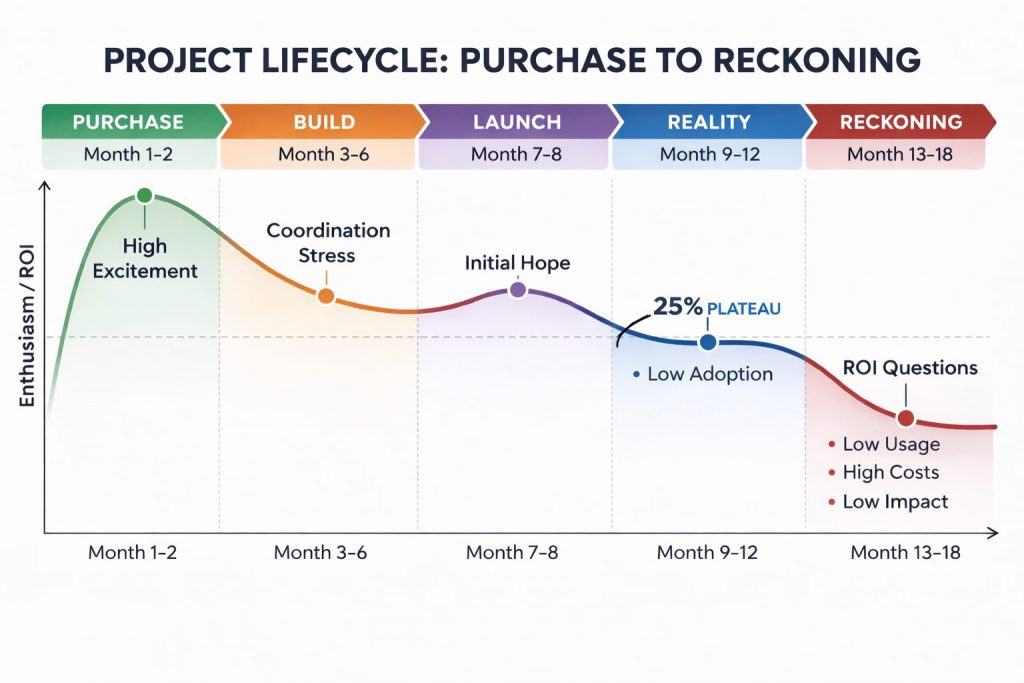
Because traditional platforms are built for captive audiences, deploying them to voluntary customers creates a predictable cycle of disappointment. Here is the exact timeline we see in nearly every mid-market SaaS company that tries to force a traditional academy model onto its user base.
Month 1-2: The Purchase
Excitement is high. Leadership believes this will finally scale the Customer Success team. You are sold on the vision of sophisticated course builders, gamification badges, and branded portals. The vendor points to massive global enterprises using the platform for compliance. You sign the contract.
Month 3-6: The Build (The Integration Nightmare)
You budgeted for an implementation partner — you knew an enterprise LMS would be a heavy lift. What you didn’t anticipate was the relentless friction of vendor-partner-internal coordination. Your team burns hours playing telephone between the LMS vendor, the external agency, and your own IT department just to untangle SSO and API integrations.
Then comes the content. Automated migration tools pull your existing knowledge base, but because the legacy architecture demands formal “courses,” the real work is just beginning. Your instructional designers and product experts must spend weeks manually massaging fluid product documentation into rigid learning paths. As the launch date looms, the uncomfortable reality sets in: this isn’t just a heavy implementation. It is a permanent operational drag.
Month 7-8: The Launch
The announcement goes out to the customer base. Initial curiosity drives a spike in traffic. A small handful of your absolute best power-users complete the flagship courses and earn their badges. The early vanity metrics (total initial logins) look promising enough to report positively to the executive team.
Month 9-12: The Reality
The novelty wears off. Adoption hits a brick wall and plateaus at 20-25%. Most customers who logged in once never return. Course completion rates hover around 15%. Most alarmingly, the Customer Success team reports that onboarding still requires heavy manual hand-holding, and support tickets regarding basic configuration are still flooding the queue.
Month 13-18: The Reckoning
It is time for budget renewals. The CFO asks: “What is the ROI on this platform?” The answer is uncomfortable. You can point to the 20% who engaged, but you cannot explain why 80% ignored it. You try promotional email campaigns and in-app pop-ups to drive traffic. Nothing moves the needle. The platform is functioning exactly as designed — but the customers are rejecting the design.
The Financial Trap of “Active User” Pricing
This 25% adoption plateau isn’t just an engagement problem; it is a massive financial trap that artificially inflates your cost to serve.
Most enterprise LMS vendors charge based on Monthly Active Users (MAUs) or tiered login blocks. During the sales process, you calculate your ROI based on the assumption that the majority of your customer base will use the platform.
If you have 2,000 total users across your customer accounts, you might buy a tier that supports 1,000 active learners, expecting a healthy 50% engagement rate. But because the architecture relies on high-friction enrollment gates, you hit the 25% plateau. Only 250 users actively log in and consume content.
The math is brutal: If you paid $30,000 for the platform expecting 1,000 active learners ($30 per user), your actual cost is now $120 per trained user. Your cost-per-outcome has quadrupled, making the financial ROI nearly impossible to justify to your RevOps and leadership.
You are paying a premium for a heavy, course-first architecture that actively suppresses the engagement you are paying to facilitate.
The Core Architectural Flaw: The Enrollment Gate
We must be very clear here: Courses are not the enemy.
Structured learning paths are incredibly valuable. When a new admin takes over your software at a client company, they need a linear onboarding course. If you offer a formal certification program that users can put on their LinkedIn profiles, courses are mandatory.
The enemy is the Enrollment Gate.
Traditional platforms treat courses as the only container for knowledge. In an enrollment-gated system, information is held hostage behind a curriculum.
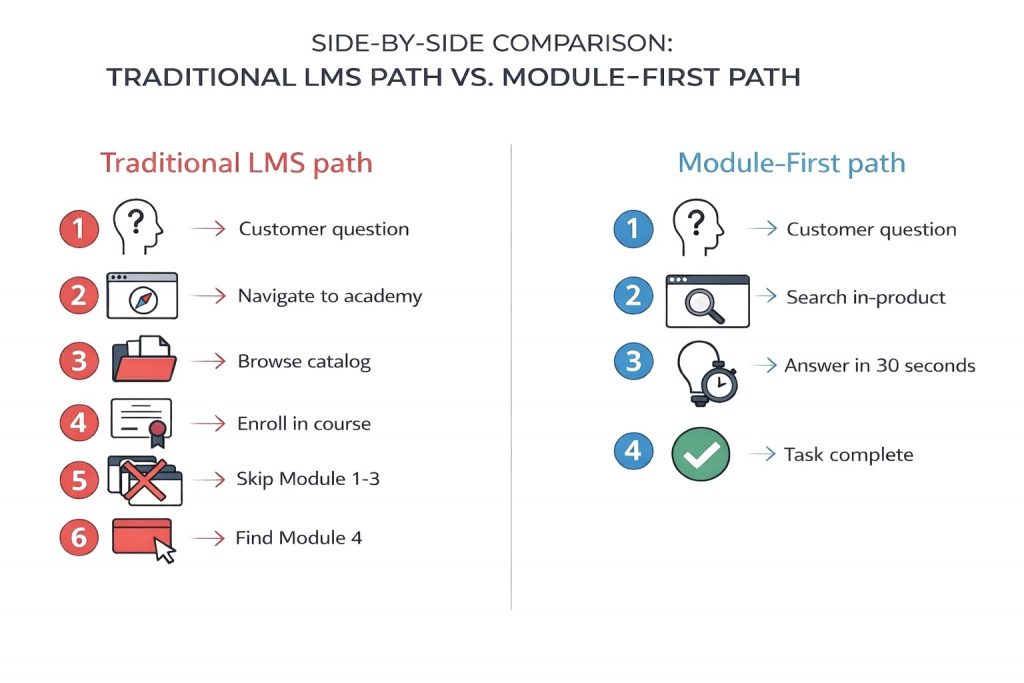
Imagine a user needs to know how to configure a custom webhook. The instructions exist. You wrote them. But in a traditional LMS, that knowledge is locked inside “Module 4” of the “Advanced Integrations” course. To read that single paragraph of text, the user must navigate to the academy, find the course, click “Enroll,” bypass the introduction, skip Modules 1 through 3, and hunt for the exact timestamp in a video.
Voluntary learners will not do this. The enrollment gate acts as a tollbooth on a highway they didn’t even want to drive on.
This is why your customer academy adoption is at 25%. The 25% who engage are either power users who genuinely want comprehensive mastery, or internal champions who have the time to sit through a curriculum.
The other 75%? They need your training just as desperately. They just refuse to pay the toll of enrollment to get a simple answer.
The Solution: Module-First Architecture (Search + Courses)
If traditional, enrollment-first platforms suppress adoption for voluntary learners, what actually works for B2B SaaS?
You do not need to abandon structured learning. You need to flip the architecture. You need a module-first structure — what we call a search-first LMS.
In a module-first architecture, content is broken down into atomic units — individual videos, articles, and guides. These modules are not trapped inside courses; they exist independently and are instantly searchable.
This creates a powerful hybrid environment that serves both the 25% who want structure, and the 75% who just want answers.
1. Search for the 75% (Immediate Intent)
For the user trying to configure a webhook at 4:00 PM, they simply type their question into an embedded search bar. The system uses semantic search to understand their intent and grounded retrieval to surface exact modules from your verified documentation — no hallucinated answers, just your actual content with source attribution. The system bypasses courses entirely and serves up the exact module explaining webhooks. Instant gratification. Zero friction. The task is completed, and the user experiences immediate value.
2. Courses for the 25% (Structured Progression)
For the new admin who needs to learn the system from scratch, those exact same independent modules are visually stacked together into a linear “Course.” They can enroll, track their progress, take assessments, and earn a certificate.
It is the exact same content. The same platform. But by building on a module-first foundation, courses become an optional overlay, not a mandatory barrier.
How Module-First Architecture Drives Real Business Outcomes
When you remove the friction of the enrollment gate, training stops being an isolated “academy” that people occasionally visit, and becomes a continuous enablement engine that drives your most critical SaaS metrics.
Outcome 1: Accelerating Customer Onboarding
Traditional onboarding relies on forcing new users through a rigid curriculum. Customer Success Managers spend the first ten minutes of every sync chasing down clients to finish the ‘101 course’ before real onboarding can begin. Most still don’t.
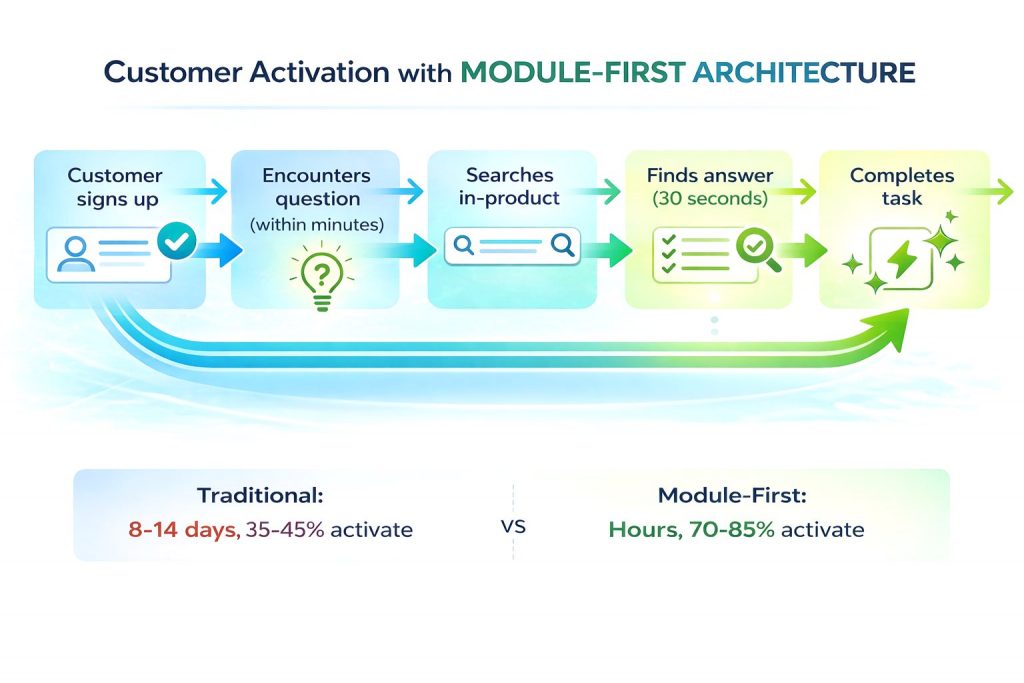
A module-first approach transforms onboarding. Yes, you can still offer the structured “Getting Started” path. But you also empower users to self-onboard dynamically. As they click around your product, they naturally have questions. Because every module is instantly searchable in the flow of work, they find answers in 30 seconds and execute the task. Instead of taking 14 days to finish a course before they start using the product, they are using the product on Day 1.
Imagine: A 200-person SaaS company with new customer onboarding averaging 12 days from signup to first meaningful usage, with 38% activating within 30 days. They switch to module-first, search-embedded architecture. New signups search directly in-product, find answers in under 60 seconds, complete their first task immediately. Within 60 days, time-to-first-value drops to 4 days and activation rate climbs to 68% — a 30-point improvement translating to 300 additional activated customers per 1,000 signups.
Outcome 2: Unlocking Feature Activation
Why do advanced features go unused? It is rarely because the feature isn’t valuable. It is almost always because the perceived effort to learn the feature outweighs the perceived benefit.
If a customer has to leave your app, log into a portal, and take a 20-minute lesson just to understand your advanced reporting suite, they will stick to basic reports. When training is embedded and module-first, exploration is cheap. A user searches “how to build custom reports,” instantly reads a 2-minute guide, and builds the report immediately. Frictionless access to knowledge is the single greatest driver of feature activation.
Outcome 3: Preventing Silent Churn
Every CS leader knows the danger of the “Ghost Ticket” — the moment a customer encounters a roadblock, tries to find the answer, fails, and doesn’t open a support ticket. They just sigh, close the laptop, and mentally downgrade your software’s value.
Traditional academies are blind to this. If a user doesn’t enroll in a course, the LMS records nothing. Search-first platforms capture this intent. Because users search for answers directly, the system tracks exactly what they are looking for. If 40 users search for “API rate limits” and you don’t have a module for it, the platform flags it as a Content Gap. You can build the exact piece of content your users are demanding, eliminating friction before it silently metastasizes into churn.
How to Transition to Module-First Architecture
You don’t need to rip out your existing academy overnight. Start with a focused pilot that proves ROI before committing to full migration.
Step 1: Pick One High-Friction Workflow (Week 1)
Identify your highest support ticket generator — SSO configuration, API setup, custom reporting. Start with 20-30 core modules covering that workflow.
Step 2: Make It Searchable Without Enrollment (Week 2-3)
Upload those modules to a search-first platform. Embed the search where customers already work. Track: search volume, intent resolution rate, support tickets on that topic.
Step 3: Measure Impact (Week 4-8)
After 30-60 days, compare support tickets before and after. Expected: 30-40% ticket reduction on pilot topics. If you’re handling 40 SSO tickets per month at $50 per ticket ($2,000/month), a 35% reduction saves $700/month or $8,400/year on one workflow alone.
Calculate your potential ROI: Use our training ROI calculator.
The 25% Rule Does Not Have to Be Permanent
If you are currently staring at an analytics dashboard showing a 25% adoption rate, take a deep breath. This plateau has persisted across every major LMS platform for years. Not because the courses are bad. Not because customers don’t need training. Because the architecture demands enrollment when customers just want answers.
You cannot force voluntary learners to care about your curriculum. You cannot force them to navigate your branded portal. You cannot force them to enroll in courses when they just want to solve a problem.
When you transition from an enrollment-first mindset to a module-first architecture, you stop fighting human psychology and start working with it. You eliminate the third-party implementation partners. You eliminate the MAU pricing traps. And most importantly, you eliminate the friction between your customer and their success.
For comprehensive customer onboarding training strategies, see our complete guide.
For analysis of AI architectures in customer training, read our AI promise vs. reality piece.
FAQ
Do we have to delete all our existing courses to go module-first?
No. Your existing videos, PDFs, and articles are uploaded and instantly made searchable as individual modules. You can then easily stack those modules into structured courses for formal onboarding or certification. You keep your courses; you just remove the gates hiding the content inside them.
If learning is voluntary, how do we track compliance or certification?
A hybrid platform supports both. For daily ad-hoc questions, users search and find answers without formal tracking. For scenarios requiring formal certification (partner programs, compliance training), you require enrollment in that specific course. The platform tracks completion, issues certificates, and reports compliance exactly like a traditional system.
How does this impact the “Usage-Based Pricing” problem?
Because search-first architecture removes enrollment friction, adoption rates typically jump from 25% to 60-80% in pilot customers. When the majority of your user base actively uses the platform, your cost-per-trained-user drops dramatically. You finally get ROI on the “active users” you’re paying for while simultaneously driving down support costs.
