What this guide covers
Where Skilljar works well, where it falls short for mid-market B2B SaaS customer training, and when a search-first alternative like Beetsol is the better architectural fit. If you’re evaluating other platforms, see our comparisons of Docebo, Thought Industries, Absorb LMS, TalentLMS, and LearnUpon.
For broader context on modern customer training strategies, see our complete customer training LMS guide.
Skilljar dominates the customer training LMS market for enterprise SaaS companies. But dominance doesn’t mean it’s the right fit for every business.
If you’re a mid-market SaaS company (50-500 customers) evaluating Skilljar and feeling uncertain about the complexity, implementation timeline, or pricing structure, you’re not alone. Many teams discover that Skilljar’s enterprise-focused architecture doesn’t align with how their customers actually learn.
What Skilljar Does Well
Before discussing alternatives, it’s important to understand what Skilljar actually excels at.
Enterprise-Grade Infrastructure
Skilljar was built for enterprise scale. The platform handles:
- Thousands of simultaneous learners
- Complex organizational hierarchies
- Multi-tenant customer academies
- Advanced SSO and security requirements
- Compliance and certification management
For companies selling to Fortune 500 enterprises, these capabilities matter.
Comprehensive Course Management
Skilljar’s course builder is robust. Teams can create:
- Multi-module learning paths
- Prerequisite-based progressions
- Assessments and certifications
- Branded customer academies
- Detailed completion tracking
For companies that need formal training programs with structured curricula, Skilljar delivers.
White-Label Customization
Skilljar allows deep branding customization. Customer academies can match corporate identity precisely, maintaining brand consistency across the learning experience.
Established Ecosystem
Skilljar has been around since 2013. The platform integrates with major CRMs, marketing automation tools, and business systems. There’s documentation, a support team, and a community of practitioners.
How Search-First Architecture Delivers Different Outcomes Than Skilljar
Beetsol is a full-featured LMS with search-first, module-first architecture. Here’s how our technical capabilities translate directly to measurable business outcomes compared to traditional course-first platforms:
These outcomes are enabled by search-first, module-first architecture. See the detailed technical breakdown →
Where Skilljar Falls Short (and Why)
Skilljar’s strengths become limitations when customer behavior doesn’t match the course-based model.
1. Course-First Architecture vs. Question-First Learning
The problem: Skilljar organizes content into courses, modules, and lessons. Customers must navigate through this structure to find answers.
For a detailed framework on how this navigation friction translates to preventable support tickets, see How to Reduce Support Tickets Through Customer Training.
This structural mismatch is why training adoption stalls at 20-25% across all course-based platforms, regardless of feature sophistication. Full analysis →
Why it matters: Modern SaaS customers don’t want to enroll in courses. They want to type a question and get an immediate answer. When your customer searches “how do I set up SSO” and the answer is buried in Module 4 of the “Advanced Configuration” course, they’ll open a support ticket instead.
These structural issues are common across traditional LMS platforms. For a deeper analysis of why course-based training consistently underperforms, see our guide on why customer training fails and how to fix it.
Real impact: One pilot customer migrated from a traditional course-based platform to a search-first system and saw support tickets about documented features drop 38% within 60 days. The content was identical. The difference was findability.
2. Long Implementation Timelines
The problem: Skilljar implementations typically take 2-4 months for mid-market companies. This includes content migration, course structuring, integration setup, and custom branding.
Why it matters: Teams need results in weeks, not quarters. Every month spent implementing is a month where customers continue struggling, support volume stays high, and onboarding remains manual.
For comparison: Modern alternatives implement in 1-3 days. Upload content, configure search, embed in your product, and go live.
3. Pricing Complexity for Mid-Market
The problem: Skilljar pricing isn’t transparent. Quotes typically start around $30,000-50,000 annually for mid-market companies, with significant variation based on learner volume, features, and contract terms.
Why it matters: For a 200-customer SaaS company, this represents significant budget allocation without guaranteed ROI. If implementation takes 3 months and adoption takes another 3-6 months, you’re 9 months into a contract before seeing real impact.
4. Low Content Utilization Rates
The problem: Course-based platforms see 20-30% completion rates on average. This means 70-80% of training content goes unused, not because it’s bad, but because customers can’t find it when they need it.
Why it matters: You’re paying for a platform where most content delivers zero value. The ROI calculation breaks when utilization is that low.
5. Separate Academy Creates Context-Switching
The problem: Skilljar academies live on separate domains. Customers must leave your product, log in separately, navigate a new interface, and search again.
Why it matters: Each step introduces friction. Customers won’t complete 5 steps to find one answer. They’ll message support or give up entirely.
What works better: Embedded learning that surfaces answers inside the product workflow, without requiring customers to context-switch.
Who Should Consider Skilljar Alternatives
Not everyone needs to replace Skilljar. But specific companies find better outcomes with different platforms.
You’re Likely a Good Fit for Alternatives If:
- You’re a mid-market SaaS company (50-500 customers)
- Skilljar’s enterprise features exceed your needs
- Implementation timelines are too long
- Pricing feels disproportionate to value
- Your customers need instant answers, not courses
- Support tickets are mostly “how do I” questions
- Customer onboarding focuses on activation, not certification
- Feature adoption matters more than course completion
- You want to launch in days, not months
- You have existing training content that just needs to be searchable
- You can’t wait 3-6 months for implementation
- You need to prove ROI quickly
- You prioritize self-service over structured learning
- Customers are self-directed and impatient
- They search before they browse
- Context-switching kills engagement
- You need embedded learning, not separate academies
- Training must happen inside your product
- Separate logins create abandonment
- You want training integrated into workflows
You Should Probably Stick with Skilljar If:
- You sell to large enterprises exclusively
- Your customers expect branded academies
- Complex organizational hierarchies are required
- Compliance and certification are critical
- You need formal training programs
- Certification programs generate revenue
- Partner enablement requires structured curricula
- Compliance mandates sequential learning paths
- You have dedicated training staff
- Full-time team managing customer education
- Resources to maintain course structures
- Bandwidth for 3-month implementations
Beetsol: A Search-First Skilljar Alternative
Beetsol is built on a fundamentally different premise: customers search before they browse, and training should adapt to this reality.
How Beetsol Works Differently
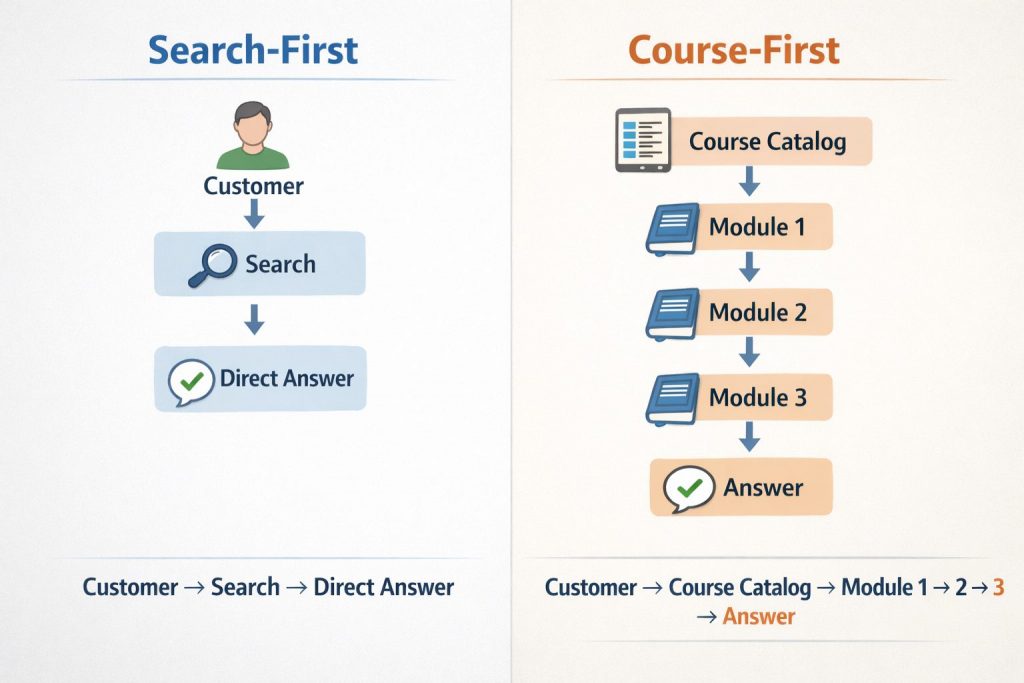
1. Search-First, Course-Optional Architecture
Upload your existing videos, PDFs, SCORM files, presentations, and documents. Beetsol’s AI automatically indexes everything and makes it instantly searchable. No course restructuring required.
Customers can:
- Search and find specific answers in seconds
- Consume content independently (no prerequisites)
- Follow structured learning paths (if they want guidance)
Both approaches work with the same content. Customers choose their learning style.
Example: A customer searches “API rate limits.” They land directly at the 2-minute explanation, not a 30-minute “API Integration Course.”
2. Deep Search That Understands Intent
Traditional keyword search fails because customers don’t know your terminology. Beetsol uses vector embeddings (pgvector) to understand the meaning of a customer’s question, not just the keywords.
How it works:
- Content is converted into mathematical representations (embeddings) that capture semantic meaning
- When a customer searches, their question is compared to content embeddings
- Results are ranked by conceptual similarity, not keyword matching
Example:
- Customer searches: “how do I give someone access”
- Skilljar finds: Documents containing the words “give,” “someone,” “access” (often irrelevant)
- Beetsol finds: “User Permissions,” “Invite Team Members,” “Role-Based Access Control” (conceptually related, even without keyword match)
This semantic understanding means customers find answers even when they use completely different terminology than your documentation.
Learn more about how Deep Search works →
3. Embedded Learning Without Context-Switching
Beetsol embeds directly into your product, help center, or support workflows. Customers get answers without leaving what they’re doing.
4. Modular Content That Ages Gracefully
When a feature changes, update one 2-minute module instead of re-recording entire courses. Content maintenance becomes manageable instead of overwhelming.
5. Analytics That Matter
Beetsol shows:
- What customers search for but can’t find (content gaps)
- Where customers drop off (friction points)
- Which content correlates with feature adoption (what actually works)
These insights drive continuous improvement instead of vanity metrics.
Explore Beetsol’s analytics capabilities →
💡 Understanding “AI-Powered” in Modern LMS Platforms
Many legacy LMS platforms are adding “AI features” as afterthoughts — typically GPT wrappers that generate slide decks, quiz questions, or course outlines.
Beetsol is AI-native: vector embeddings and semantic search power the platform from the ground up, not as bolt-on features. This architectural difference means:
- Better intent understanding (finds answers customers need, not just keyword matches)
- Lower false positives (relevance threshold prevents irrelevant results)
- Search gap analytics (shows what customers look for but can’t find)
The question isn’t “Does it have AI?” but “Is AI solving the core problem (findability) or just generating more content to get lost in?”
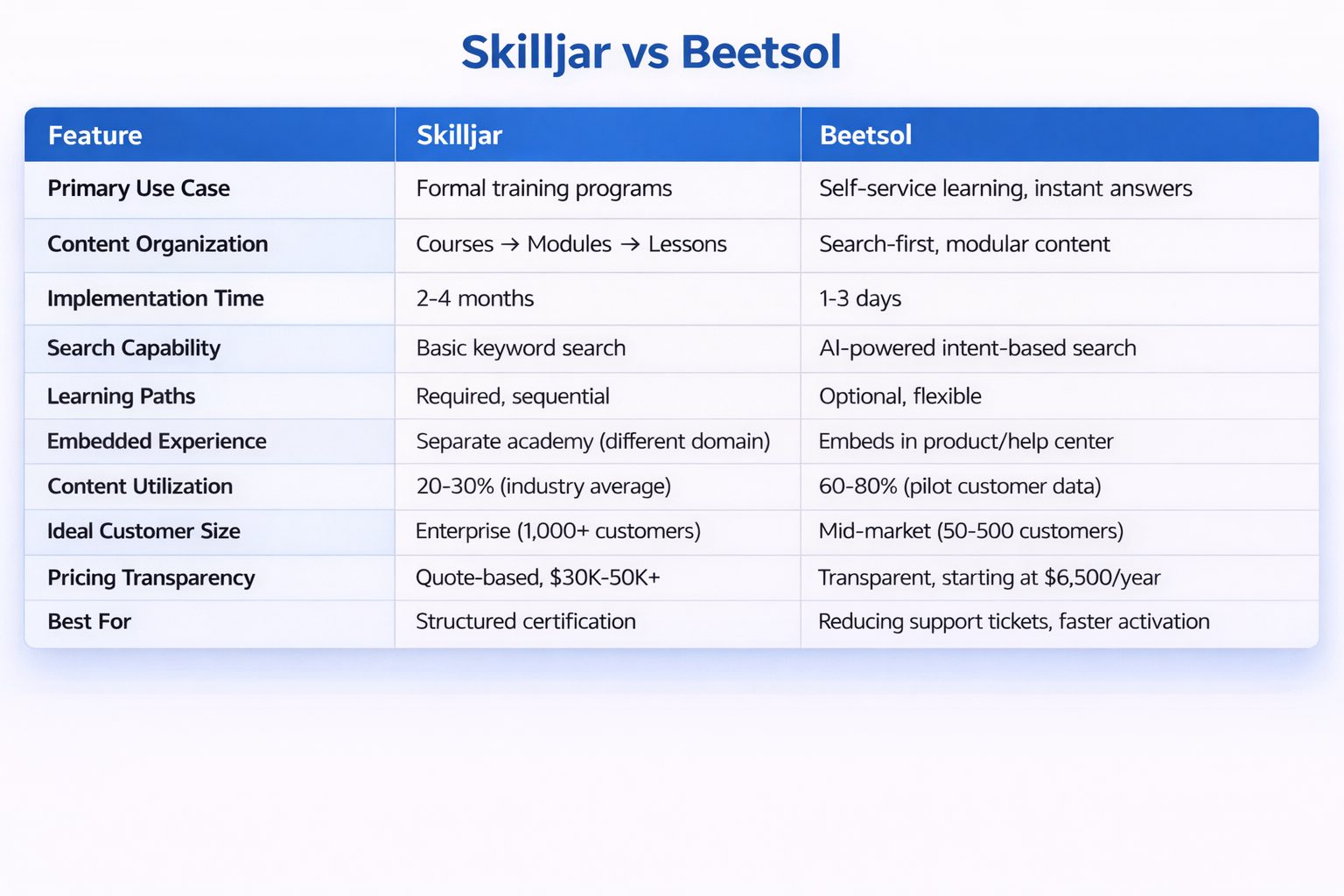
Feature Comparison: Skilljar vs Beetsol
| Feature | Skilljar | Beetsol |
|---|---|---|
| Primary Use Case | Formal training programs | Self-service learning, instant answers |
| Content Organization | Courses → Modules → Lessons | Search-first, modular content |
| Implementation Time | 2-4 months | 1-3 days |
| Search Capability | Basic keyword search | AI-powered intent-based search |
| Learning Paths | Required, sequential | Optional, flexible |
| Embedded Experience | Separate academy (different domain) | Embeds in product/help center |
| Content Utilization | 20-30% (industry average) | 60-80% (pilot customer data) |
| Ideal Customer Size | Enterprise (1,000+ customers) | Mid-market (50-500 customers) |
| Pricing Transparency | Quote-based, $30K-50K+ | Transparent, starting at $6,500/year |
| Best For | Structured certification | Reducing support tickets, faster activation |
Pricing Comparison
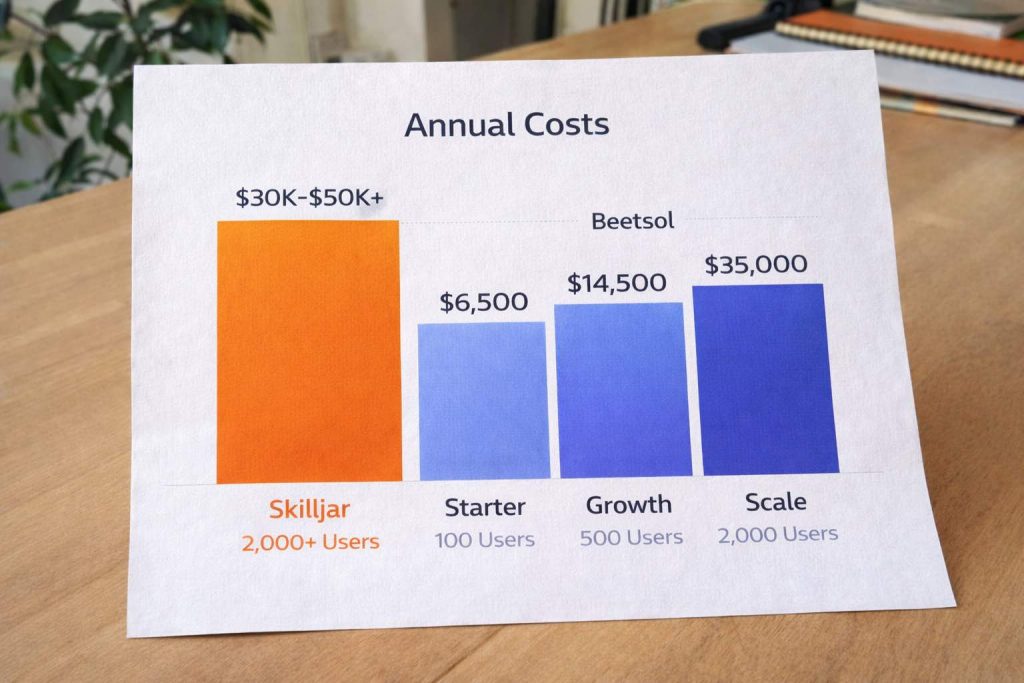
Skilljar Pricing
- Not publicly listed
- Quote-based model
- Typical range: $30,000-$50,000+ annually for mid-market
- Additional costs for custom features, integrations, professional services
- Long-term contracts (typically 1-2 years)
Beetsol Pricing
- Transparent, published pricing
- Starter: $6,500/year (up to 100 active learners)
- Growth: $15,500/year (up to 250 active learners)
- Scale: $27,000/year (up to 500 active learners)
- Implementation included, no professional services fees
- Month-to-month or annual contracts
“Active learners” = An active learner is anyone who logs in or searches in a calendar month, counted once no matter how often they return. Each plan includes a set number of active learners, provisioning is unlimited and free, and anyone above your plan is billed at a flat $7 per active learner per month.
Every Beetsol feature is included at every tier — semantic search, content gap detection, embedded learning, analytics — all available on Starter. The tiers differ only in active learner count. No capability gating. No add-ons. View complete pricing details →
Cost difference: A 200-customer company pays $15,500/year with Beetsol vs $35,000-45,000/year with Skilljar — a 58-67% savings while gaining faster implementation and higher content utilization.
Calculate Your Own ROI
Use Beetsol’s ROI calculator to estimate your actual savings based on your support ticket volume, customer count, and current LMS costs.
Calculate your potential savings →
The calculator accounts for:
- Support ticket deflection (typically 20-35% reduction based on industry data)
- Faster customer onboarding (15-30% time reduction)
- Current LMS costs eliminated
- Net implementation costs
Most mid-market SaaS companies see payback in 3-6 months when factoring in support cost savings alone.
Implementation Timeline Comparison
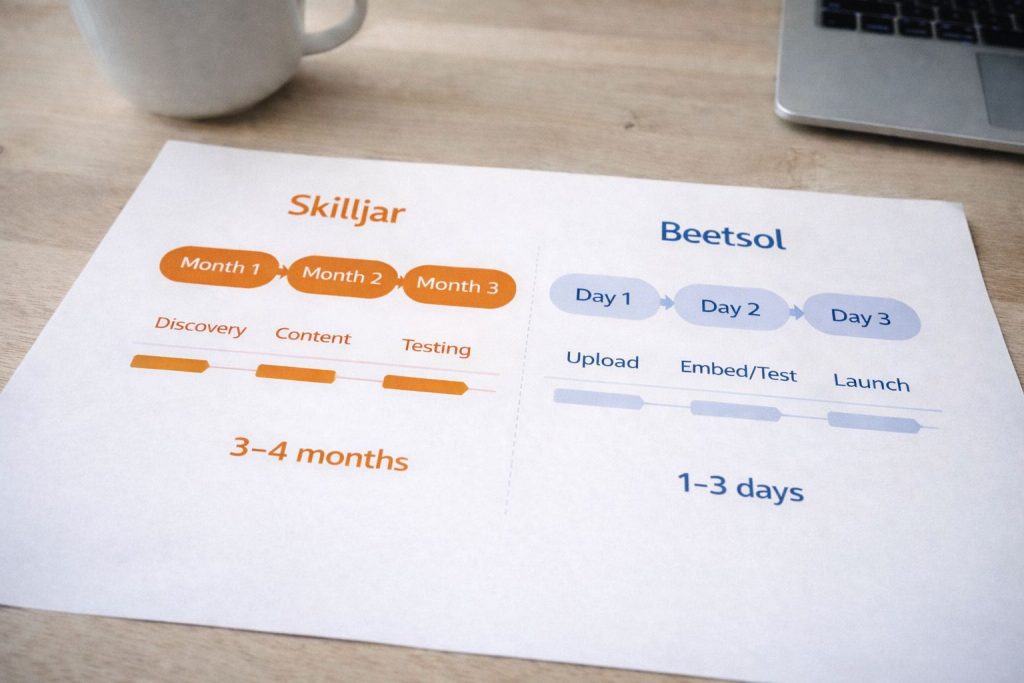
Skilljar Implementation
Month 1:
- Discovery calls and requirements gathering
- Content audit and migration planning
- Custom branding design
Month 2:
- Content restructuring into courses
- Integration configuration
- Custom development (if needed)
Month 3:
- Testing and QA
- Admin training
- Soft launch
Month 4:
- Full rollout
- Optimization begins
Total: 3-4 months to go-live
Beetsol Implementation
Day 1:
- Upload existing content (videos, docs, PDFs)
- AI auto-indexes and makes searchable
- Configure basic settings
Day 2:
- Embed in product or help center
- Test search functionality
- Customize branding
Day 3:
- Launch to customers
- Begin tracking usage
Total: 1-3 days to go-live
The difference: 90-120 days vs 1-3 days. That’s 3-4 months where customers are already getting value instead of waiting.
Use Case Fit: When Each Platform Makes Sense
Choose Skilljar When:
- You need formal certification programs
- Generating revenue from partner training
- Compliance certifications required
- Sequential mastery progression matters
- You serve enterprise customers exclusively
- Complex organizational hierarchies
- Multi-tenant academies required
- Dedicated training administrators at customer sites
- You have training staff and long timelines
- Full-time customer education team
- 6-12 month planning cycles acceptable
- Resources for ongoing course maintenance
Choose Beetsol When:
- You need to reduce support tickets
- 40%+ of tickets are “how do I” questions
- Customers ask about documented features
- Support team wants to focus on complex issues
- You want faster customer activation
- Time-to-value is critical for retention
- Customers need instant answers during onboarding
- Self-service reduces CSM dependency
- You have content but low engagement
- Training exists but completion rates are <30%
- Customers don’t know where to find answers
- Separate academies create abandonment
- You need embedded learning
- Context-switching kills engagement
- Training must happen inside product workflows
- Customers are self-directed learners
Other Skilljar Alternatives to Consider
Beetsol isn’t the only alternative. Depending on your specific needs, other platforms may fit:
Docebo
- Best for: Global enterprises needing AI-powered L&D, 40+ languages, learning commerce, and compliance tracking
- Strengths: Most feature-rich LMS available, extensive integration ecosystem, native e-commerce
- Weaknesses: Overwhelming complexity for mid-market, 3-6 month implementation, high total cost of ownership
- Pricing: $25,000-$200,000+/year (quote-based)
- For a detailed comparison, see our Docebo alternative guide.
Thought Industries
- Best for: Mid-market companies needing strong API capabilities and native e-commerce for monetizing training
- Strengths: Flexible API, partner certification programs, customizable content delivery
- Weaknesses: Still course-first architecture, requires engineering resources to leverage API, opaque pricing
- Pricing: $25,000-$40,000/year (quote-based)
- For a detailed comparison, see our Thought Industries comparison.
Absorb LMS
- Best for: Companies training multiple audiences (employees, customers, partners) from one platform
- Strengths: Multi-audience portals, mid-market pricing, cleaner interface than enterprise LMS
- Weaknesses: Course-first architecture, not specialized for customer training, 2-3 month implementation
- Pricing: $20,000-$50,000/year (quote-based)
- For a detailed comparison, see our Absorb LMS alternative guide.
TalentLMS
- Best for: Small businesses (under 50 customers) needing budget-friendly employee training
- Strengths: Lowest entry price, fast setup, clean learner interface
- Weaknesses: No semantic search, features gated behind expensive tiers, charges for registered users not active
- Pricing: $119-$779/month depending on tier and user count
- For a detailed comparison, see our TalentLMS alternative guide.
LearnUpon
- Best for: SMBs needing simple course delivery with basic multi-audience support
- Strengths: Clean interface, faster implementation than enterprise platforms
- Weaknesses: Still course-first, limited search, basic analytics
- Pricing: Starts at ~$599/month
- For a detailed comparison, see our LearnUpon alternative guide.
Why Beetsol stands out: It’s the only platform purpose-built around search-first, modular learning for B2B SaaS customer training specifically.
How to Evaluate Your Skilljar Alternative
If you’re considering switching from Skilljar or evaluating alternatives, use this framework:
1. Define Your Primary Goal
Is it:
- Reduce support tickets by 30%+?
- Decrease time-to-value for new customers?
- Improve feature adoption rates?
- Scale customer education without adding headcount?
- Build formal certification programs?
Your answer determines which platform fits best.
2. Assess Your Content Reality
Ask:
- Do we have existing training content? (videos, docs, presentations)
- Is it currently organized in courses or scattered across tools?
- How often does it need updating?
- Who maintains it?
If you have content that just needs to be findable: Search-first platforms like Beetsol excel.
If you need to build structured curricula from scratch: Course-focused platforms like Skilljar may fit better.
3. Understand Customer Learning Behavior
Observe:
- Do customers complete courses or abandon them?
- Do they search or browse?
- Where do they currently get stuck?
- What questions do they ask support repeatedly?
If customers search and abandon courses: You need better discovery, not more structure.
If customers complete structured programs: Course-based platforms work for your audience.
4. Calculate True Total Cost
Include:
- Platform fees (annual contract value)
- Implementation costs (professional services, internal time)
- Opportunity cost (revenue lost during 3-month implementation)
- Maintenance burden (hours spent updating courses vs modules)
A $30K platform that takes 4 months to implement has higher true cost than a $15K platform that launches in 3 days.
5. Test With Real Content and Users
Before committing:
- Request a pilot with your actual content
- Have 5-10 real customers use the platform
- Track: Can they find answers? Do they get stuck? What’s the experience?
Vendor demos don’t reveal real-world performance. Pilot testing does.
Real Migration Stories
The following examples are based on pilot customer data and early implementation results. Individual results vary based on content quality, customer base, and implementation approach.
Example: Mid-Market SaaS Company Migration
Background (based on pilot data):
- ~280 B2B customers
- Previously using traditional course-based LMS
- 22% course completion rate
- Support tickets rising despite training investment
The challenge:
- Customers weren’t completing courses
- “How do I” tickets persisted for documented features
- High annual LMS costs without proportional value
Approach:
- Ran pilot with search-first platform
- Uploaded existing content (no restructuring required)
- Made everything searchable
- Embedded in product help center
Results after 90 days (pilot data):
- Support tickets about trained topics: -35%
- Content utilization: 22% → 64%
- Time-to-first-meaningful-action: 12 days → 5 days
Key insight: The content quality was never the problem — discoverability was.
Example: Fast Implementation for Growing Company
Background (based on pilot data):
- ~150 customers
- Evaluating multiple LMS platforms
- 3-4 month implementation timeline considered too long for business needs
Approach:
- Chose search-first platform for speed
- Went live in under 1 week
- Started seeing support deflection within 2 weeks
Results after 6 months (pilot data):
- Faster time-to-value than projected with traditional LMS
- 40% reduction in basic “how to” tickets
- Higher content engagement rates
Key insight: Speed to value mattered more than feature completeness for this company’s customer base.
Making the Switch: What to Expect
If you decide to move from Skilljar to an alternative like Beetsol, here’s what the process looks like:
Phase 1: Content Export (Week 1)
- Export all videos, documents, and course materials from Skilljar
- Audit what’s still relevant vs outdated
- Identify gaps or missing content
Phase 2: Platform Setup (Week 1-2)
- Upload content to new platform
- Configure search and indexing
- Set up branding and customization
- Integrate with existing tools (CRM, support, product)
Phase 3: Soft Launch (Week 2-3)
- Test with internal team first
- Run pilot with 10-20 customers
- Gather feedback on search quality and findability
- Optimize based on real usage
Phase 4: Full Rollout (Week 3-4)
- Announce new platform to all customers
- Sunset old Skilljar academy
- Monitor adoption and usage
- Track support ticket trends
Total migration timeline: 3-4 weeks vs starting from scratch.
Common Objections to Switching
“We’ve already invested in Skilljar.”
Sunk cost fallacy. The question isn’t “How much have we spent?” but “What’s the ROI going forward?”
If Skilljar isn’t delivering results, continuing to pay for it doesn’t honor past investment — it compounds the loss.
“Our customers are used to the academy.”
Usage data often tells a different story. Check actual completion rates and engagement. If only 20-30% of customers actively use the academy, “used to it” isn’t accurate.
“We have custom integrations built.”
Modern platforms offer APIs and webhooks. Most integrations can be rebuilt in days, not months. The question is: Do those integrations drive outcomes, or just complexity?
“Search-first sounds risky. What if it doesn’t work?”
Run a pilot. Upload your content to Beetsol, test with real customers for 30 days, and measure:
- Can customers find answers faster?
- Do support tickets decrease?
- Is content utilization higher?
Data removes risk better than debates.
FAQ
Can Beetsol replace Skilljar completely?
For most mid-market B2B SaaS companies: yes. Beetsol handles customer onboarding, feature training, and support deflection better than course-based platforms.
For companies that need formal certification programs generating revenue: Skilljar may still be necessary.
How long does migration take?
Content export from Skilljar: 1-2 days
Upload and configuration in Beetsol: 1-2 days
Testing and launch: 1-3 days
Total: 1 week for basic migration, 2-3 weeks for full rollout
What happens to our existing content?
Everything migrates. Videos, PDFs, SCORM files, presentations, documents — all upload directly. Beetsol auto-indexes and makes it searchable. No reformatting required.
Do we lose course structure entirely?
No. Beetsol supports courses and learning paths for customers who want structure. The difference: customers aren’t forced into courses. They can search and find specific answers OR follow guided paths. Both work with the same content.
What about analytics and reporting?
Beetsol tracks what matters:
- Search queries (what customers look for)
- Content gaps (what they search for but can’t find)
- Drop-off points (where they abandon)
- Adoption correlation (which training drives feature usage)
This is more actionable than course completion rates.
How does pricing work for growing companies?
Beetsol plans are priced by active learners:
- Starter covers up to 100 active learners at $6,500/year
- Growth up to 250 at $15,500/year
- Scale up to 500 at $27,000/year
- Enterprise has custom volumes above 500.
An active learner is anyone who logs in or searches in a calendar month. Provisioning is unlimited and free, and active learners above your plan are billed at a flat $7 per learner per month.
Can we try before committing?
Yes. Beetsol offers 30-day pilots with your actual content and real customers. Test search quality, content utilization, and support ticket impact before making a decision.
Next Steps
If Skilljar isn’t delivering the outcomes you need, you have options.
Start with these questions:
- What’s our current course completion rate? (If under 40%, courses aren’t working)
- What percentage of support tickets are about features covered in training? (If over 30%, training isn’t findable)
- How long did Skilljar take to implement? (If over 2 months, was the delay worth it?)
- What’s our true annual cost including implementation and maintenance? (Often 1.5-2x the quoted platform fee)
For a comprehensive framework on building effective customer training programs that customers actually use, explore our customer training LMS strategy guide.
Then:
- Request a Beetsol pilot with your actual content
- Run it alongside Skilljar for 30 days
- Compare: findability, utilization, support ticket trends
- Let data guide your decision
In an era where SaaS companies build AI co-pilots to eliminate friction everywhere, maintaining enrollment gates for customer training creates strategic misalignment. Learn why activation speed matters more than ever in usage-based SaaS
The right platform makes customer training a growth driver instead of a cost center. Customers who can find answers independently activate faster, adopt more features, and stay longer.
Explore how Beetsol transforms customer training →