What this guide covers
Where Docebo works well, where it becomes overkill for B2B SaaS customer training, and when a search-first alternative like Beetsol is the better architectural fit. If you’re evaluating other platforms, see our comparisons of Skilljar, Thought Industries, Absorb LMS, TalentLMS, and LearnUpon.
For broader context on modern customer training strategies, see our complete customer training LMS guide.
Docebo is one of the most feature-rich learning management systems available, serving major enterprises across industries. But feature richness comes with complexity — and complexity comes with costs that extend far beyond the subscription price.
If you’re a mid-market B2B SaaS company (50-500 customers) evaluating Docebo and feeling overwhelmed by the platform’s scope, long implementation timeline, or enterprise-focused pricing, you’re experiencing what many teams discover: Docebo was built for large organizations with dedicated training departments, not lean SaaS teams that need customers to find answers quickly.
When to choose Docebo over Beetsol: If your primary mandate is internal employee L&D, global compliance tracking across 40+ languages, learning commerce capabilities to monetize training programs, or you’re managing thousands of courses across complex organizational hierarchies with dedicated training departments. Docebo is an unmatched enterprise powerhouse for these use cases.
When to choose Beetsol over Docebo: If your goal is B2B SaaS customer training focused on activation speed, support ticket deflection, and self-service learning. Customer education requires instant answers in the flow of work, not enrollment-gated courses. If you need customers to activate in days (not weeks) and can’t wait 3-6 months for implementation, Beetsol’s search-first architecture delivers 60-80% adoption vs the 25% plateau common in course-based platforms.
What Docebo Does Well
Before discussing alternatives, it’s important to understand what Docebo excels at — and why course-first architecture works exceptionally well for specific use cases. Docebo represents the pinnacle of traditional LMS platforms built for comprehensive enterprise learning programs. This architecture is ideal for employee training, compliance, and formal education programs where structured progression and completion tracking matter.
Comprehensive AI-Powered Features
Docebo invests heavily in AI capabilities including:
- Content recommendations based on learner behavior
- Automated tagging and content organization
- Predictive analytics for learning outcomes
- Personalized learning paths
For large enterprises managing thousands of learners across complex organizations, these AI features provide genuine value.
Enterprise-Scale Infrastructure
Docebo handles massive scale effectively:
- Tens of thousands of simultaneous users
- Multi-language support (40+ languages)
- Complex hierarchical structures
- Advanced compliance and audit requirements
- White-label multi-tenant environments
For global enterprises with distributed teams and customers, this infrastructure matters.
Extensive Integration Ecosystem
Docebo integrates with hundreds of business systems including:
- Major CRMs (Salesforce, HubSpot, Microsoft Dynamics)
- HRIS systems (Workday, SAP SuccessFactors)
- Content authoring tools
- Video conferencing platforms
- Business intelligence tools
The platform’s API and connector ecosystem enables deep workflow automation.
Learning Commerce Capabilities
Like few competitors, Docebo includes native e-commerce functionality for monetizing training:
- Payment processing
- Subscription management
- Course catalogs and marketplaces
- Revenue reporting
Organizations generating revenue from training programs find this valuable.
Robust Reporting and Analytics
Docebo provides sophisticated reporting including:
- Custom report builders
- Learning analytics dashboards
- Compliance tracking and audit trails
- Predictive insights
April 2026: AgentHub and Enterprise Knowledge
At Inspire 2026, Docebo announced its largest release to date, introducing Enterprise Knowledge (connecting 20+ external content sources), Companion (a browser extension for in-workflow learning), AgentHub (AI-powered course creation), Skills Intelligence via 365Talents, and an MCP Server.
While tools like Enterprise Knowledge and Companion work toward making information findable where people work, they ultimately funnel users back into the same legacy architecture: content trapped inside a portal, gated by enrollment. Even their newest AI agent is designed to scrape existing wikis just to generate more 15-minute courses.
The question isn’t whether the AI on top is sophisticated; the question is whether the underlying course-based model is the exact reason customer training adoption has plateaued. When users just need a specific, two-minute answer to keep moving, automating the creation of more courses doesn’t solve the friction — it just scales it.
How Search-First Architecture Delivers Different Outcomes Than Enterprise LMS
Beetsol is a full-featured LMS with search-first, module-first architecture. Here’s how our technical capabilities translate directly to measurable business outcomes compared to enterprise course-first platforms:
Faster Activation
Customers reach value in days instead of weeks by getting in-context answers exactly when they get stuck.
ENABLED BY:
AI-Native Semantic Search (pgvector) for intent understanding. Surfaces specific answers within content instantly, not just keyword matching.
Training Adoption
Delivering 4x higher engagement than the 20% industry average for legacy, enrollment-gated platforms.
ENABLED BY:
Module-First Architecture where content is searchable without course enrollment. Supports both instant answers and structured learning paths from the same content.
Ticket Deflection
Documented features stop generating expensive “how-to” support tickets because users find answers instantly.
ENABLED BY:
Search Gap Analytics that track what customers search for but can’t find. Identifies content gaps before they become support tickets.
Feature Adoption
Searchable, module-first training drives natural discovery and usage of secondary product capabilities.
ENABLED BY:
In-Product Search Widget embedded directly in your application. Customers get instant answers without leaving their workflow or navigating separate portals.
Docebo excels at enterprise-scale global L&D infrastructure with comprehensive AI-powered features. Beetsol maintains full course, certification, and learning path capabilities while eliminating enrollment friction through search-first architecture — optimized specifically for B2B SaaS customer education.
This architectural difference between AI-native search-first and course-first platforms determines not just features, but fundamental outcomes. Read our complete analysis: The AI Promise vs. Reality in B2B SaaS Customer Training.
Where Docebo Becomes Overkill
Docebo’s enterprise capabilities become friction points when applied to B2B SaaS customer training. The fundamental issue isn’t features — it’s the course-first architecture that forces voluntary learners through enrollment gates when they need instant answers. This structural mismatch is what creates the 25% adoption plateau we consistently see across traditional LMS platforms, regardless of how sophisticated their features are.
1. Overwhelming Complexity for Simple Use Cases
The problem: Docebo offers hundreds of features across multiple modules. For a mid-market SaaS company that simply needs customers to find training quickly, this creates unnecessary complexity.
Why it matters: More features mean more configuration, more decisions, more training for admins, and more ongoing maintenance. When your core need is “help customers find answers fast,” spending weeks configuring advanced learning analytics doesn’t move the needle.
Real impact: Teams spend months learning Docebo’s admin interface before they can effectively manage training. The learning curve for the platform itself delays actually helping customers.
2. Enterprise Pricing for Mid-Market Budgets
The problem: Docebo pricing typically starts around $25,000+ annually for mid-market companies, often reaching $40,000-60,000+ when including necessary features and user volumes.
Why it matters: For a 200-customer SaaS company, this represents significant budget allocation — often equivalent to hiring a full-time customer education specialist. The question becomes: does the platform deliver proportional value?
Hidden costs: Beyond subscription fees, Docebo implementations require professional services, ongoing customization, and dedicated admin time. Total cost of ownership often exceeds 2x the quoted platform price.
For the full breakdown of how training platform costs actually accumulate — including hidden fees most vendors don’t disclose — see our Customer Training Pricing Guide.
3. Long Implementation and Configuration
The problem: Docebo implementations typically take 3-6 months for mid-market companies, sometimes longer for complex configurations.
Why it matters: Six months of implementation means six months where customers continue struggling, support tickets remain high, and onboarding stays manual. The opportunity cost compounds daily.
For a framework on how training architecture eliminates how-to tickets specifically — the 40-60% of your queue that are questions about documented features — see How to Reduce Support Tickets Through Customer Training.
What takes so long:
- Platform configuration (settings, workflows, permissions)
- Content migration and restructuring
- Integration setup (CRM, support tools, product)
- Custom branding and white-labeling
- Admin training and documentation
- Testing and QA across multiple scenarios
4. Still Fundamentally Course-Based
The problem: Despite AI enhancements, Docebo organizes learning around courses, modules, and learning paths. Customers must navigate this structure to find specific information.
This enrollment gate is why customer training adoption stalls at 20-25% across all course-based platforms. Full analysis →
Why it matters: B2B SaaS customers don’t want courses. They want to type “how do I reset user permissions” and get an immediate answer. When the answer is buried in Module 4 of the “User Management Fundamentals” course, they’ll open a support ticket instead.
These structural challenges affect all course-based platforms, regardless of AI capabilities. For deeper analysis of why traditional training approaches consistently underperform, see our guide on why customer training fails and how modern platforms fix it.
5. Search Remains Secondary to Navigation
The problem: Docebo includes search functionality, but it’s designed to help users navigate the course catalog, not replace it. Search returns courses and learning paths, not specific answers.
Why it matters: When customers search “API authentication,” they don’t want a list of API courses. They want the specific 2-minute explanation of authentication setup. Course-first architecture makes this impossible.
6. Separate Learning Portal Creates Friction
The problem: Docebo academies exist as separate branded portals. Customers must leave your product, log in separately, navigate the portal, and search again.
Why it matters: Each step introduces abandonment risk. Customers won’t complete 5 steps to find one answer when opening a support ticket takes 30 seconds.
What works better: Embedded learning that surfaces answers exactly where customers work, without context-switching.
Who Should Consider Docebo Alternatives
Not everyone needs to replace Docebo. But specific companies find better outcomes with simpler platforms.
You’re Likely a Good Fit for Alternatives If:
- You’re a mid-market B2B SaaS company
- 50-500 customers (not 5,000+)
- Small customer success team (no dedicated training department)
- Budget constraints ($25K+ feels disproportionate)
- Docebo’s enterprise features exceed your needs
- You need speed over comprehensiveness
- Can’t wait 3-6 months for implementation
- Need to prove ROI in weeks, not quarters
- Want to launch this month, not next quarter
- Your primary goal is support ticket reduction
- 40%+ of tickets are “how do I” questions
- Customers ask about documented features repeatedly
- Support team wants to focus on complex issues
See the complete support ticket reduction framework for the math on what this category actually costs and how to eliminate it.
- Your customers need instant answers, not courses
- Self-directed, impatient B2B SaaS users
- Product usage is task-oriented, not certification-driven
- Customers search before they browse
- You don’t need enterprise complexity
- No multi-language interface requirements
- No complex organizational hierarchies
- No regulatory compliance mandates
- No need to monetize training
You Should Probably Stick with Docebo If:
- You’re a large enterprise (1,000+ customers)
- Need multi-tenant white-label academies
- Require complex organizational hierarchies
- Have a dedicated training/L&D department
- Budget aligns with enterprise pricing
- You need extensive compliance tracking
- Regulated industries (healthcare, finance, manufacturing)
- Mandatory certification requirements
- Detailed audit trails required
- Formal completion tracking critical
- You monetize training programs
- Selling courses or certifications
- Partner training generates revenue
- Need subscription management
- Require payment processing
- You need AI-powered content curation
- Thousands of courses to organize
- Personalization at scale required
- Predictive analytics drive decisions
- Content recommendations matter
Simpler Alternatives If Docebo Is Overkill
If Docebo’s enterprise complexity exceeds your needs, several platforms offer simpler approaches depending on your specific requirements and company size.
For Enterprise-Scale with Different Focus
Skilljar ($30K-$150K+/year) – Best for large enterprises (1,000+ customers) needing branded customer academies with sophisticated course management. Like Docebo, it’s course-first but more focused on external customer training than internal L&D. Implementation: 2-6 months. For a detailed comparison, see our Skilljar alternative guide.
Absorb LMS ($20K-$50K/year) – Mid-market option for companies training multiple audiences (employees, customers, partners) in one platform. Less complex than Docebo but still course-based. Implementation: 2-3 months. For a detailed comparison, see our Absorb LMS alternative guide.
For Mid-Market with Specific Needs
Thought Industries ($25K-$40K/year) – Strong API capabilities and e-commerce functionality for companies that need custom integrations or want to monetize partner training. Still course-focused. Implementation: 2-4 months. For a detailed comparison, see our Thought Industries comparison.
LearnUpon (starts ~$599/month) – Simpler interface than Docebo with basic course management. Good for straightforward training needs without enterprise complexity. Implementation: 2-4 weeks. For a detailed comparison, see our LearnUpon alternative guide.
For Budget-Conscious Teams
TalentLMS ($69-$429/month) – Basic LMS functionality at accessible pricing for small companies (under 50 customers). Limited features but easy to set up. Implementation: days to 1 week. For a detailed comparison, see our TalentLMS alternative guide.
For Search-First, Fast Implementation
Beetsol ($6.5K-$27K/year) – The only platform built specifically for search-first, modular learning. Instant answer discovery without course enrollment. Best for mid-market B2B SaaS (50-500 customers) needing fast activation, higher training adoption, and support deflection. Implementation: 1-3 days.
Comparison at a Glance
| Platform | Best For | Architecture | Implementation |
|---|---|---|---|
| Docebo | Enterprise L&D, global compliance | Course-first, AI-powered | 3-6 months |
| Skilljar | Enterprise customer academies | Course-first, white-label | 2-6 months |
| Thought Industries | Custom integrations, e-commerce | Course-first, flexible API | 2-4 months |
| Absorb LMS | Multi-audience training | Course-first, versatile | 2-3 months |
| Beetsol | Fast activation, self-service | Search-first, module-first | 1-3 days |
| LearnUpon | Simple course management | Course-first, basic | 2-4 weeks |
| TalentLMS | Budget-conscious small teams | Course-first, lightweight | Days to 1 week |
Each platform serves different needs. The key is matching platform architecture to your specific use case rather than choosing based on feature counts.
For a complete top-10 ranking with detailed analysis of each platform, see Best Customer Training Software for B2B SaaS (2026).
Beetsol: The Search-First, Module-First Alternative
Beetsol takes a fundamentally different architectural approach. Instead of organizing training around courses that customers must navigate, Beetsol organizes around the questions customers actually ask. This module-first architecture means content exists as atomic, instantly searchable units — not trapped inside sequential courses. Customers search, find answers in seconds, and move on. When structured learning is needed for onboarding or certification, those same modules can be assembled into optional learning paths without duplicating content.
How Beetsol Works Differently
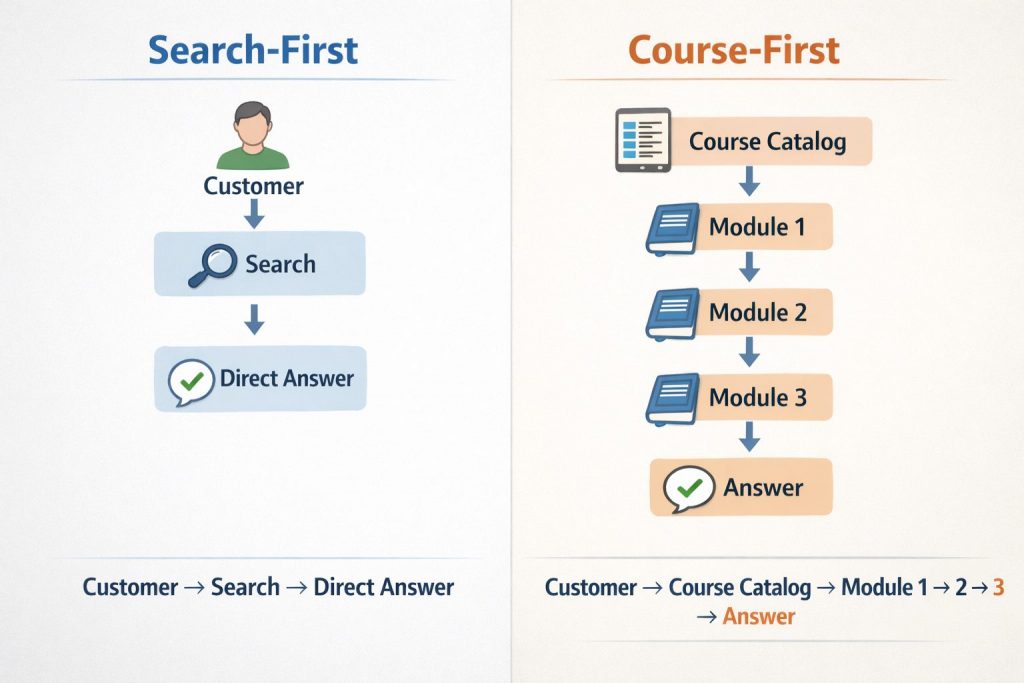
Search-First, Course-Optional Architecture
Upload existing videos, PDFs, SCORM files, presentations, and documents. Beetsol’s AI automatically indexes everything and makes it instantly searchable. No course restructuring required.
Customers can:
- Search and find specific answers in seconds
- Consume content independently (no prerequisites)
- Follow structured learning paths (if they want guidance)
Both approaches work with the same content. Customers choose their learning style.
Semantic Search That Understands Intent
Docebo’s search looks for keywords. Beetsol uses vector embeddings (pgvector) to understand the meaning of customer questions.
How it works:
- Content is converted into mathematical representations (embeddings) that capture semantic meaning
- When a customer searches, their question is compared to content embeddings
- Results are ranked by conceptual similarity, not keyword matching
Example:
- Customer searches: “how do I let someone else access my account”
- Docebo finds: Courses containing “access” and “account” (often irrelevant)
- Beetsol finds: “User Permissions,” “Invite Team Members,” “Delegate Access” (conceptually related)
This semantic understanding means customers find answers even when they use completely different terminology than your documentation.
Learn more about how Deep Search works →
Days to Launch, Not Months
Beetsol implementations take 1-3 days:
- Day 1: Upload content, AI auto-indexes
- Day 2: Embed in product, test search
- Day 3: Launch to customers
No multi-month professional services engagement. No extensive configuration. No admin training curriculum.
Embedded Learning Without Context-Switching
Beetsol embeds directly into your product, help center, or support workflows. Customers get answers without leaving what they’re doing.
No separate portal. No different login. No navigation to another site.
Intent Resolution Over Completion Tracking
Beetsol measures whether customers found their answer (intent resolution) in addition to course completions.
The platform’s analytics show:
- What customers search for but can’t find (content gaps)
- Where customers exit without resolution (friction points)
- Which content correlates with feature adoption (what actually works)
These insights reveal where training fails, not just completion percentages.
💡 Understanding “AI-Powered” in Modern LMS Platforms
Both Docebo and Beetsol mention AI capabilities, but the implementations differ fundamentally.
Docebo uses AI to enhance course delivery: content recommendations, automated tagging, predictive analytics. These features optimize the course-based model but don’t change its core architecture.
Beetsol is AI-native: vector embeddings and semantic search power the platform from the ground up, not as add-on features. This architectural difference means:
- Better intent understanding (finds answers customers need, not just keyword matches)
- Lower false positives (relevance threshold prevents irrelevant results)
- Search gap analytics (shows what customers look for but can’t find)
The question isn’t “Does it have AI?” but “What problem does AI solve?” For Docebo, AI enhances course management. For Beetsol, AI enables instant answer discovery.
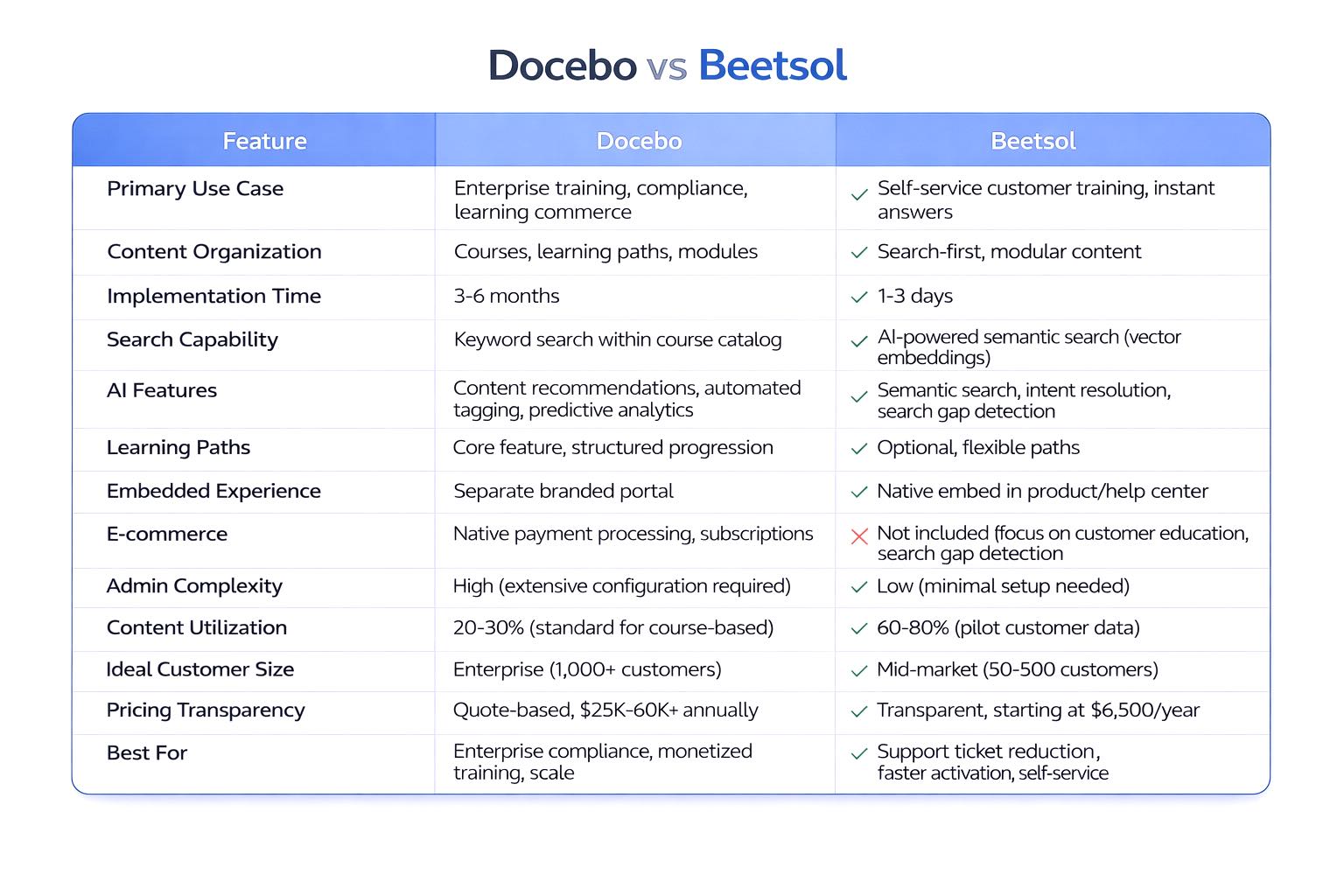
Feature Comparison: Docebo vs Beetsol
| Feature | Docebo | Beetsol |
|---|---|---|
| Primary Use Case | Enterprise training, compliance, learning commerce | Self-service customer training, instant answers |
| Content Organization | Courses, learning paths, modules | Search-first, modular content |
| Implementation Time | 3-6 months | 1-3 days |
| Search Capability | Keyword search within course catalog | AI-powered semantic search (vector embeddings) |
| AI Features | Content recommendations, automated tagging, predictive analytics | Semantic search, intent resolution, search gap detection |
| Learning Paths | Core feature, structured progression | Optional, flexible paths |
| Embedded Experience | Separate branded portal | Native embed in product/help center |
| E-commerce | Native payment processing, subscriptions | Not included (focus on customer education, not monetization) |
| Admin Complexity | High (extensive configuration required) | Low (minimal setup needed) |
| Content Utilization | 20-30% (standard for course-based) | 60-80% (pilot customer data) |
| Ideal Customer Size | Enterprise (1,000+ customers) | Mid-market (50-500 customers) |
| Pricing Transparency | Quote-based, $25K-60K+ annually | Transparent, starting at $6,500/year |
| Best For | Enterprise compliance, monetized training, global scale | Support ticket reduction, faster activation, self-service |
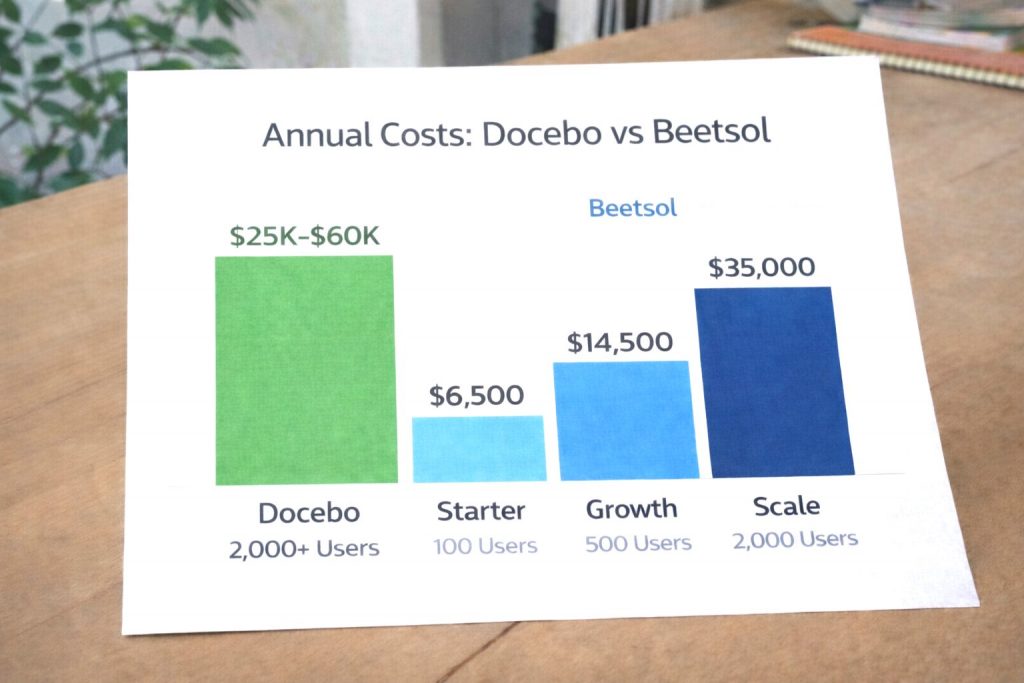
Pricing Comparison
Docebo Pricing
- Not publicly listed
- Quote-based model
- Typical range: $25,000-$60,000+ annually for mid-market
- Pricing varies significantly by user volume, features, modules
- Additional costs for professional services (often $10K-30K)
- Ongoing costs for customization and integrations
- Long-term contracts (typically 2-3 years)
Hidden costs: Implementation services, custom development, admin training, ongoing maintenance often push total cost of ownership to 1.5-2x the quoted platform price.
Beetsol Pricing
- Transparent, published pricing
- Starter: $6,500/year (up to 100 active learners)
- Growth: $15,500/year (up to 250 active learners)
- Scale: $27,000/year (up to 500 active learners)
- Implementation included, no professional services fees
- No hidden costs or surprise invoices
- Month-to-month or annual contracts
“Active Learners” = An active learner is anyone who logs in or searches in a calendar month, counted once no matter how often they return. Each plan includes a set number of active learners, provisioning is unlimited and free, and anyone above your plan is billed at a flat $7 per active learner per month.
View complete Beetsol pricing details →
Cost difference: A 200-customer company pays $15,500/year with Beetsol vs $35,000-50,000/year with Docebo — a 60-70% savings while gaining faster implementation and higher content utilization.
Calculate Your Own ROI
Use Beetsol’s ROI calculator to estimate your actual savings based on your support ticket volume, customer count, and current LMS costs.
Calculate your potential savings →
The calculator accounts for:
- Support ticket deflection (typically 20-35% reduction based on industry data)
- Faster customer onboarding (15-30% time reduction)
- Current LMS costs eliminated
- Opportunity cost of delayed implementation
Most mid-market SaaS companies see payback in 3-6 months when factoring in support cost savings alone.
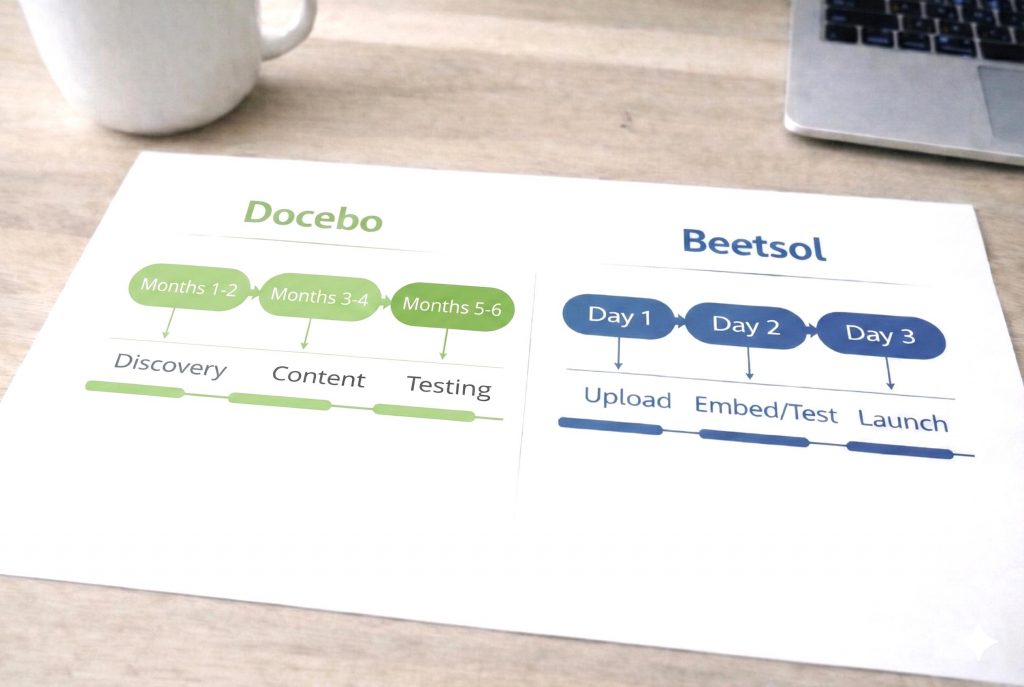
Implementation Timeline Comparison
Docebo Implementation
Month 1-2: Planning and Configuration
- Discovery workshops and requirements gathering
- Platform architecture design
- Integration planning
- Initial configuration setup
Month 3-4: Content and Integration
- Content migration and restructuring
- Course building and organization
- API integrations development
- Custom branding implementation
Month 5-6: Testing and Launch
- User acceptance testing
- Admin training program
- Phased rollout to users
- Post-launch optimization
Total: 4-6 months to go-live (typical for mid-market)
Beetsol Implementation
Day 1:
- Upload existing content (videos, docs, PDFs)
- AI auto-indexes and makes searchable
- Configure basic settings
Day 2:
- Embed in product or help center
- Test search functionality
- Customize branding (logo, colors)
Day 3:
- Launch to customers
- Begin tracking usage and intent resolution
Total: 1-3 days to go-live
The difference: 120-180 days vs 1-3 days. That’s 4-6 months where customers are already getting value instead of waiting for implementation to complete.
For companies on usage-based pricing, every month of delayed implementation is directly measurable lost revenue. See why activation speed is a revenue metric.
Use Case Fit: When Each Platform Makes Sense
Choose Docebo When:
- You’re a global enterprise with complex needs
- Multi-language interface requirements (40+ languages)
- Complex organizational hierarchies
- Thousands of learners across geographies
- Dedicated L&D department managing training
- You need extensive compliance tracking
- Regulated industries (healthcare, finance, manufacturing)
- Mandatory certification requirements
- Detailed audit trails and reporting
- Formal completion tracking critical
- You monetize training programs
- Selling courses or certifications
- Partner training generates revenue
- Need payment processing and subscriptions
- Course marketplace required
- You need AI-powered content management at scale
- Thousands of courses to organize
- Personalization across diverse learner populations
- Predictive analytics drive strategy
- Automated content curation required
Choose Beetsol When:
- You need to reduce support tickets
- 40%+ of tickets are “how do I” questions
- Customers ask about documented features repeatedly
- Support team wants to focus on complex issues
- Ticket volume growing faster than revenue
- You want faster customer activation
- Time-to-value is critical for retention
- Customers need instant answers during onboarding
- Self-service reduces CSM dependency
- Early churn is a problem
- You need to launch quickly
- Can’t wait 4-6 months for implementation
- Need to prove ROI in weeks, not quarters
- Budget won’t support multi-month professional services
- Small team managing customer education
- Your customers are self-directed
- B2B SaaS users (technical, impatient)
- Customers search before they browse
- Task-oriented product usage
- Context-switching kills engagement
- You don’t need enterprise complexity
- No multi-language interface requirements
- No complex organizational hierarchies
- No need to monetize training
- Simple use case: help customers find answers
Real-World Scenarios
The following examples are based on pilot customer data and early implementation results. Individual results vary based on content quality, customer base, and implementation approach.
Scenario 1: Mid-Market SaaS Company
Background (pilot data):
- ~350 B2B customers
- Evaluated Docebo ($45K quote, 4-month implementation)
- Needed faster solution due to rising support costs
Decision:
- Chose Beetsol for speed and simplicity
- Launched in 5 days
- Saved $30K annually
Results after 90 days:
- Support tickets about trained topics: -32%
- Customer onboarding time: 14 days → 7 days
- ROI positive within 2 months
Key insight: “We didn’t need all of Docebo’s features. We needed customers to find answers quickly. Beetsol solved that specific problem without the complexity.”
Scenario 2: Global Enterprise Staying with Docebo
Background:
- 5,000+ customers globally
- Multi-language interface requirements (15 languages)
- Complex compliance tracking needs
- Dedicated 4-person training team
Decision:
- Docebo’s complexity matched their needs
- Budget supported $80K annual cost
- 6-month implementation acceptable given scale
Why it worked:
- Scale justified enterprise platform
- Compliance requirements needed Docebo’s audit capabilities
- Team had bandwidth to manage complexity
Common Objections to Switching
“We’ve already invested in Docebo.”
Sunk cost fallacy. The question isn’t “How much have we spent?” but “What’s the ROI going forward?”
If Docebo’s complexity exceeds your needs and simpler alternatives deliver better outcomes, continuing to pay for unused features doesn’t honor past investment — it compounds the loss.
“But Docebo has AI features we might need.”
Ask yourself: Do you need AI-powered content recommendations for thousands of courses, or do you need customers to find specific answers quickly?
More AI features don’t automatically mean better outcomes. The question is whether AI solves your actual problem.
“What if we grow and need Docebo’s scale?”
Beetsol scales to 2,000+ active learners. If you eventually grow beyond that and need enterprise complexity, you can migrate.
But paying for enterprise scale before you need it doesn’t make financial sense.
“Simpler platforms sound risky.”
Run a pilot. Test Beetsol with your actual content and real customers for 30 days. Measure:
- Can customers find answers faster?
- Do support tickets decrease?
- Is content utilization higher?
Data removes risk better than feature checklists.
Migrating from Docebo: Step-by-Step Roadmap
If you decide to migrate from Docebo to a simpler alternative, here’s a realistic timeline and process.
Phase 1: Content Audit and Export (Week 1)
- Export all videos, documents, SCORM packages, and course materials from Docebo
- Audit what’s still relevant vs outdated content that can be retired
- Identify content gaps or missing documentation
- Document which content gets the most usage (worth prioritizing)
Phase 2: Platform Setup and Configuration (Week 1-2)
- Upload content to new platform (Beetsol: 1-2 days; others: varies)
- Configure search indexing and semantic understanding
- Set up branding, white-labeling, and visual customization
- Integrate with existing tools (CRM, support desk, product)
- Configure SSO and user provisioning
Phase 3: Soft Launch and Testing (Week 2-3)
- Test internally with CS team first (validate search quality)
- Run pilot with 10-20 customers from different segments
- Gather feedback on findability and user experience
- Optimize content organization based on actual search patterns
- Monitor support ticket trends during pilot
Phase 4: Full Rollout and Sunset (Week 3-4)
- Announce new platform to all customers with clear benefits
- Provide grace period where both platforms are available
- Gradually redirect traffic from old Docebo academy to new platform
- Transition off Docebo after 2-4 weeks
- Track adoption metrics: search usage, content utilization, support tickets
Total migration timeline: 3-4 weeks for Beetsol (vs 3-6 months to implement Docebo initially)
Key success factors:
- Don’t try to recreate Docebo’s course structure — embrace simpler, search-first approach
- Focus on making top 20% of content (that drives 80% of value) searchable first
- Let pilot data guide decisions rather than trying to port every Docebo feature
- Measure outcomes (activation speed, ticket reduction) not feature parity
Making Your Decision
Here’s a framework for deciding on the best alternative for Docebo:
Step 1: Define Your Core Problem
Is it:
- Customers can’t find training when they need it? → Search-first platform
- Need to manage thousands of courses across global organization? → Enterprise LMS
- Support tickets rising despite existing documentation? → Search-first platform
- Complex compliance and audit requirements? → Enterprise LMS
- Need to monetize partner training programs? → Enterprise LMS with e-commerce
Step 2: Assess Your Resources
Do you have:
- 4-6 months for implementation? If no → Simpler platform
- $40K+ annual budget? If no → Simpler platform
- Dedicated training team? If no → Simpler platform
- Time to learn complex admin interface? If no → Simpler platform
Step 3: Match Complexity to Needs
Simple test:
- List the 5 outcomes you need from customer training
- Score each platform on those specific outcomes (not feature counts)
- Choose the platform that delivers those outcomes with least complexity
More features aren’t better if they don’t drive your specific outcomes.
FAQ
Can Beetsol replace Docebo completely?
For most mid-market B2B SaaS companies focused on customer onboarding, support deflection, and feature adoption: yes. Beetsol handles these use cases better than enterprise platforms.
For enterprises needing multi-language interface support, complex compliance tracking, learning commerce, or managing thousands of courses: Docebo remains necessary.
What happens to our existing Docebo content?
All content migrates: videos, PDFs, SCORM files, presentations, documents. Beetsol auto-indexes and makes it searchable. No reformatting required.
What doesn’t migrate: Course structures, learning path configurations, custom integrations. These need rebuilding (or may not be necessary in a search-first model).
How long does migration take?
Content export from Docebo: 2-3 days
Upload to Beetsol: 1 day
Testing and launch: 1-2 days
Total: 1-2 weeks for full migration
What about Docebo’s AI features?
Docebo’s AI enhances course management and content recommendations. Beetsol’s AI enables semantic search and intent understanding.
Different problems, different solutions. If your core need is “help customers find answers quickly,” semantic search matters more than content recommendations.
Do we lose learning analytics?
No — you gain different analytics. Instead of course completions, you track:
- Search queries and success rates
- Content gaps (what customers look for but can’t find)
- Intent resolution (did they find their answer?)
- Feature adoption correlation
These insights are often more actionable than completion percentages.
Can we pilot both platforms?
Yes. Run Beetsol alongside Docebo for 30 days with the same content. Compare:
- Implementation time
- Customer findability
- Support ticket trends
- Content utilization rates
- Admin effort required
Let data guide your decision.
What if we need features Beetsol doesn’t have?
First, ask: Do you need those features, or do you need outcomes?
Many Docebo features are “nice to have” but don’t drive core outcomes. If you genuinely need multi-language interface support, learning commerce, or complex compliance tracking, Docebo may be necessary.
But if your core need is faster customer activation and support ticket reduction, feature gaps may not matter.
For deeper understanding of how modern customer training platforms work differently than traditional enterprise LMS systems, explore our complete guides on reducing support tickets, measuring ROI, and accelerating customer onboarding.
What is the best alternative for Docebo if we only train customers?
If your primary focus is B2B SaaS customer and partner training rather than heavy internal HR compliance, Beetsol is the most efficient alternative for Docebo. Its search-first architecture strips away the bloat of traditional enrollment gates, getting your users to “Aha!” moments in days rather than months.
How do we handle the transition communication to customers?
Most customers will appreciate simpler, faster training if you frame it correctly:
- “We’re making it easier to find answers — just search and go” (emphasize benefit, not change)
- Provide side-by-side comparison showing old way (navigate → enroll → module 3) vs new way (search → answer)
- Highlight that all their existing progress and certificates are preserved
- Run both platforms for 2-3 weeks so early adopters can test without pressure
In practice, most customers won’t notice or care about the backend change — they’ll just find training works better.
What about our custom Docebo integrations and workflows?
Evaluate each integration: Is it driving outcomes, or just complexity?
Critical integrations (SSO, CRM user sync, support desk) can be rebuilt in days with modern APIs. Many Docebo customizations were built to work around course-first limitations and won’t be necessary in search-first platforms.
Ask: “What outcome does this integration enable?” Then build toward that outcome, not feature parity.
Can we run Beetsol alongside Docebo during evaluation?
Yes. Run a 30 day pilot with:
- Same content uploaded to both platforms
- Split test: 50% of customers see Beetsol, 50% see Docebo
- Compare: search success rates, time-to-answer, support ticket volume, content utilization
- Measure: which platform drives faster activation and higher feature adoption
Data removes risk better than vendor promises or feature comparisons.
Next Steps
If Docebo feels like overkill for your needs, you have options.
Start with these questions:
- What percentage of Docebo’s features do we actually use? (If under 30%, you’re overpaying)
- How long has implementation taken? (If over 4 months, opportunity cost is mounting)
- What’s our support ticket volume for documented features? (If over 30%, training isn’t findable)
- Could we achieve our goals with simpler tools? (Honest answer matters)
For comprehensive guidance on building effective customer training programs that customers actually use, see our customer training LMS strategy guide.
Then:
- Request a Beetsol pilot with your actual content
- Test with 10-20 real customers for 30 days
- Compare outcomes: findability, utilization, support tickets
- Choose based on data, not feature counts
The right platform isn’t the one with the most features — it’s the one that delivers your specific outcomes with the least complexity.
See how Beetsol’s search-first approach works →