What this guide covers
Where Absorb LMS works well, where it falls short for B2B SaaS customer training, and when a search-first alternative like Beetsol is the better architectural fit. If you’re evaluating other platforms, see our comparisons of Docebo, Skilljar, Thought Industries, TalentLMS, and LearnUpon.
For broader context on modern customer training strategies, see our complete customer training LMS guide.
Absorb LMS markets itself as a versatile platform that can handle any training scenario — employee onboarding, customer education, partner enablement, compliance tracking, and more. This “do everything” approach appeals to organizations that want one system for all training needs.
But versatility comes with a cost: specialization. When a platform tries to serve every audience and every use case equally well, it often serves none of them exceptionally. If you’re a mid-market B2B SaaS company (50-500 customers) evaluating Absorb LMS and questioning whether its all-purpose design actually fits your customer training needs, you’re experiencing what many teams discover: customer education requires a different architecture than employee L&D or compliance training.
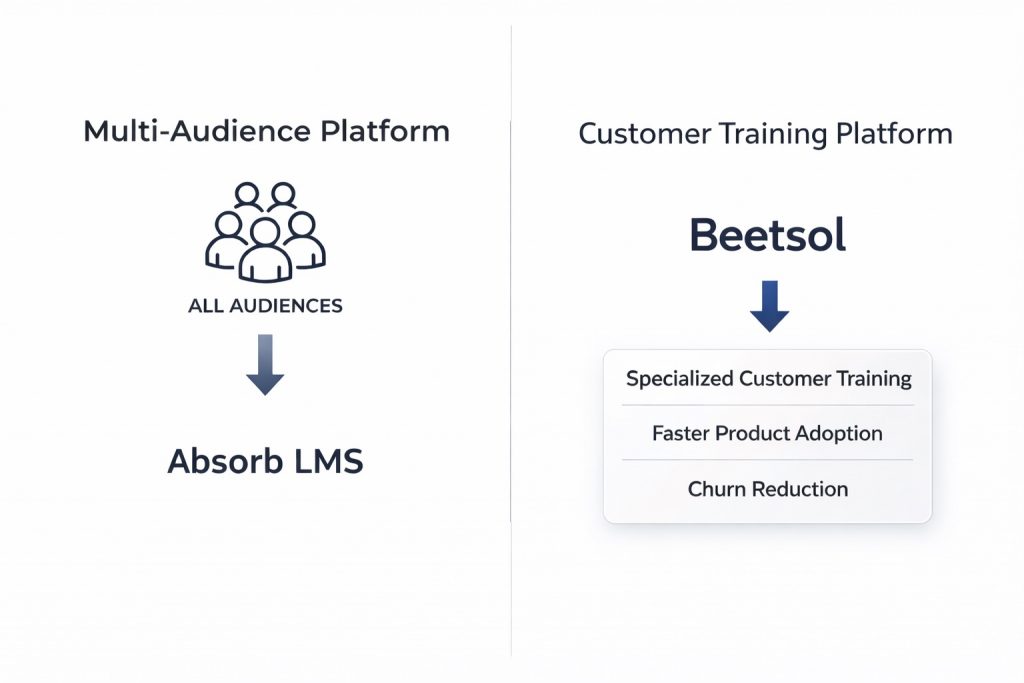
When to choose Absorb LMS over Beetsol: If you need one platform to train multiple audiences (employees, customers, and partners) with different content libraries for each, and you value having a Swiss Army knife solution that handles diverse training scenarios. Absorb excels as a versatile, all-purpose LMS for organizations with varied training needs across different groups.
When to choose Beetsol over Absorb LMS: If your primary focus is B2B SaaS customer training and you need specialization over versatility. Absorb tries to serve everyone, which means it’s optimized for no one. Customer education requires search-first architecture for instant answers, not a platform where customer training is one of many use cases. If you need customers to activate in days and find answers without navigating course catalogs, Beetsol’s module-first approach delivers 60-80% adoption vs the 25% plateau typical of course-based systems.
What Absorb LMS Does Well (And Why Multi-Audience Architecture Works for Some)
Before discussing alternatives, it’s important to understand what Absorb LMS excels at — and why its multi-audience, course-first architecture works well for specific organizational needs. Absorb represents a middle ground: more approachable than enterprise behemoths like Docebo, but more comprehensive than single-purpose platforms. This positioning makes sense when you genuinely need to train multiple distinct audiences from one system.
True Multi-Audience Support
Absorb LMS can manage separate portals and content libraries for:
- Internal employees (onboarding, compliance, professional development)
- External customers (product training, feature adoption)
- Channel partners (sales enablement, certification)
- Contractors and temporary staff
Each audience gets their own branded experience, content catalog, and learning paths — all managed from one admin dashboard. For organizations that actually need to train all these groups, this consolidation matters.
Solid Mid-Market Pricing
Absorb pricing typically ranges from $20,000-$50,000 annually for mid-market companies, positioned between budget LMS tools (under $10K) and enterprise platforms (over $50K). This makes it accessible for growing companies without the sticker shock of Skilljar or Docebo.
Reasonable Feature Set
Absorb includes standard LMS capabilities without excessive complexity:
- Course authoring and management
- Learning paths and prerequisites
- Assessments and certifications
- Basic reporting and analytics
- Mobile learning support
- Integration with common tools (CRM, HRIS, SSO)
The feature set is comprehensive without being overwhelming — a deliberate middle ground.
Faster Implementation Than Enterprise LMS
Absorb implementations typically take 2-3 months for mid-market companies, compared to 3-6 months for platforms like Docebo or Skilljar. While not fast by modern standards, it’s faster than enterprise alternatives.
Decent User Interface
Absorb’s interface is cleaner and more intuitive than older enterprise LMS platforms, though still organized around traditional course catalogs and navigation structures.
How Customer Training Specialization Delivers Different Outcomes Than Multi-Audience Platforms
Beetsol is a full-featured LMS with search-first, module-first architecture built specifically for B2B SaaS customer education. Here’s how specialization translates directly to measurable business outcomes compared to multi-audience platforms:
These outcomes are enabled by customer training specialization — not multi-audience versatility. See the detailed breakdown with technical capabilities →
Where Absorb LMS Falls Short for Customer Training Specifically
Absorb’s multi-audience versatility becomes a limitation when your primary need is B2B SaaS customer training. The platform’s “serve everyone equally” design means customer education — which requires fundamentally different architecture than employee compliance training — doesn’t get the specialization it needs.
1. Jack of All Trades, Master of None
The problem: Absorb prioritizes breadth over depth. It can handle employee onboarding, partner certification, and customer training, but it’s not optimized for any of them. Customer training gets the same course-based architecture designed for mandatory employee compliance — despite voluntary learners behaving completely differently.
Why it matters: B2B SaaS customers don’t want to enroll in courses. They want to search “how do I reset permissions” and get an immediate answer. When your platform treats customer education the same as employee onboarding, you get the same 25% adoption plateau that besets all course-based systems — regardless of how many audiences they can serve.
The result: 40-60% of support tickets remain how-to questions about documented features — the most expensive and most preventable category in your queue. See the full ticket reduction framework.
These architectural challenges are common across traditional LMS platforms that try to serve multiple use cases. For deeper analysis of why course-based training consistently underperforms for customers specifically, see our guide on why customer training fails and how modern platforms fix it.
2. Still Fundamentally Course-First
The problem: Despite being more modern than legacy LMS systems, Absorb organizes learning around courses, modules, and learning paths. Customers must navigate this structure to find specific information.
Why it matters: This enrollment gate creates friction for voluntary learners. When customers need a quick answer about API configuration, they don’t want to browse the course catalog, find the relevant course, enroll, navigate to Module 4, and watch a 20-minute video. They want to search, find a 2-minute explanation, and get back to work.
Real impact: Course-first architecture forces customers through 5-7 steps to access information that should take one search. Each step introduces abandonment risk — which is why these platforms average 20-25% adoption for voluntary learning.
3. Multi-Audience Complexity Customers Never See
The problem: Absorb’s multi-audience capabilities require significant admin configuration: separate portals, content libraries, user groups, permissions, and branding. This complexity exists to serve the platform’s versatility promise — but your customers never see or benefit from it.
Why it matters: You’re paying for and configuring multi-audience infrastructure when you only need customer training. It’s like buying a Swiss Army knife when you only need scissors — you pay for features you don’t use, and the tool is more complex than necessary.
4. Search Remains an Afterthought
The problem: Absorb includes search functionality, but it’s keyword-based and designed to help users navigate the course catalog, not replace it. Search returns courses and learning paths, not specific answers.
Why it matters: When customers search “SSO configuration,” they don’t want a list of courses that might contain that information. They want the specific 3-minute tutorial on SSO setup. Course-first platforms can’t deliver this because content is trapped inside sequential courses.
5. Implementation Still Takes Months
The problem: While faster than enterprise LMS (2-3 months vs 3-6 months), Absorb implementations still require significant time for content structuring, multi-audience setup, integration configuration, and testing.
Why it matters: Three months of implementation means three months where customers continue struggling, support tickets stay high, and onboarding remains manual. The opportunity cost compounds daily.
For comparison: Platforms built specifically for customer training implement in 1-3 days because they don’t require restructuring content into courses or configuring multi-audience hierarchies.
6. Pricing for Versatility You May Not Need
The problem: Absorb’s $20K-$50K pricing reflects its multi-audience capabilities and broad feature set. If you only need customer training, you’re subsidizing employee L&D and partner enablement features you’ll never use.
Why it matters: For a 200-customer SaaS company focused solely on customer education, paying $30K+ annually for multi-audience infrastructure is budget misallocation. Specialized platforms deliver better customer training outcomes at 30-50% lower cost.
For a side-by-side cost comparison across all major platforms including hidden implementation fees, see our Customer Training Pricing Guide.
This matters especially in 2026, where usage-based pricing and AI-speed expectations have raised the bar for activation. Paying for versatility you don’t use while customers take weeks to activate is a strategic liability.
Who Should Consider Absorb LMS Alternatives
Not everyone needs to replace Absorb. But specific companies find better outcomes with specialized platforms.
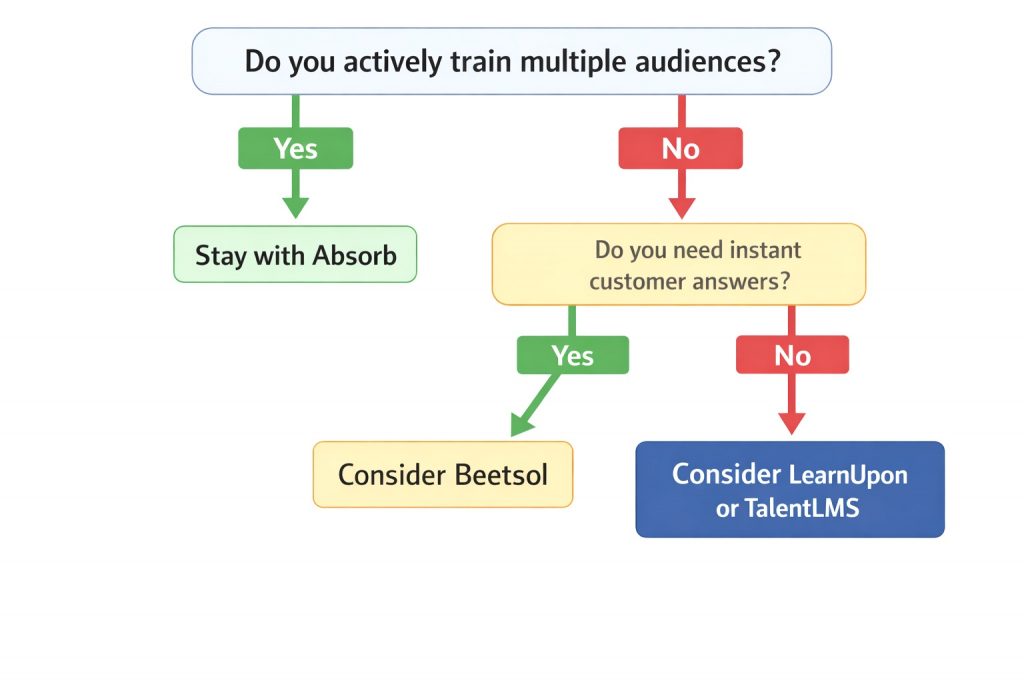
You’re Likely a Good Fit for Alternatives If:
- You’re focused primarily on customer training
- Customer education is your main use case (not employees or partners)
- You’re not actually using the multi-audience features you’re paying for
- Other portals sit mostly empty while customer training carries the load
- Your customers need instant answers, not courses
- Customer activation matters more than formal certification
- Support tickets are mostly “how do I” questions about documented features
- Self-service is more important than structured learning paths
- You want to launch fast
- Can’t wait 2-3 months for implementation
- Need to prove training ROI quickly
- Have existing content that just needs to be searchable
- You prioritize specialization over versatility
- Want a platform optimized for customer behavior specifically
- Don’t need one system for employees, customers, AND partners
- Willing to use specialized tools rather than all-in-one platforms
You Should Probably Stick with Absorb If:
- You genuinely need multi-audience training
- Actively training employees, customers, AND partners from one platform
- All three audiences have high engagement (not just customer training)
- Consolidation genuinely reduces complexity and cost
- You need formal structured programs
- Certification programs are core to your business model
- Compliance requires sequential course completion
- Partner enablement needs formal curricula
- You have dedicated training staff
- Full-time instructional designers and LMS administrators
- Resources to manage multi-audience complexity
- Team capacity to build and maintain structured courses
Other Absorb LMS Alternatives to Consider
Beyond Beetsol, several other platforms serve as Absorb alternatives depending on whether you need multi-audience versatility or customer training specialization.
For Enterprise-Scale Multi-Audience Training
Docebo ($25K-$200K+/year) – If you need Absorb’s multi-audience approach but with more enterprise features: AI-powered recommendations, 40+ languages, learning commerce, advanced analytics. Better for global enterprises with complex L&D needs. Implementation: 3-6 months. For a detailed comparison, see our Docebo alternative guide.
Skilljar ($30K-$150K+/year) – If customer training is your primary focus but you’re serving 1,000+ customers and need sophisticated branded academies. More specialized than Absorb but still course-based. Implementation: 2-6 months. For a detailed comparison, see our Skilljar alternative guide.
For Mid-Market Multi-Purpose Use
Thought Industries ($25K-$40K/year) – Similar multi-audience positioning as Absorb but with stronger API capabilities and e-commerce for monetizing training. Good if you need custom integrations. Implementation: 2-4 months. For a detailed comparison, see our Thought Industries comparison.
LearnUpon (starts ~$599/month) – Simpler multi-audience LMS without Absorb’s complexity. Good for straightforward training needs across employees and customers. Implementation: 2-4 weeks. For a detailed comparison, see our LearnUpon alternative guide.
For Budget-Conscious Teams
TalentLMS ($69-$429/month) – Basic multi-audience functionality at accessible pricing for very small companies (under 50 customers). Limited features but easy setup. Implementation: days to 1 week. For a detailed comparison, see our TalentLMS alternative guide.
For Customer Training Specialization
Beetsol ($6.5K-$27K/year) – The only platform built specifically for B2B SaaS customer training with search-first, module-first architecture. Not multi-audience because it doesn’t need to be — specialized for voluntary learners who need instant answers. Implementation: 1-3 days.
The key question: Do you actually need to train multiple audiences from one platform, or are you paying for versatility you don’t use? If customer education is your primary mandate, specialized architecture delivers better outcomes than multi-purpose platforms.
For the full top-10 ranking with detailed feature analysis, see Best Customer Training Software for B2B SaaS (2026).
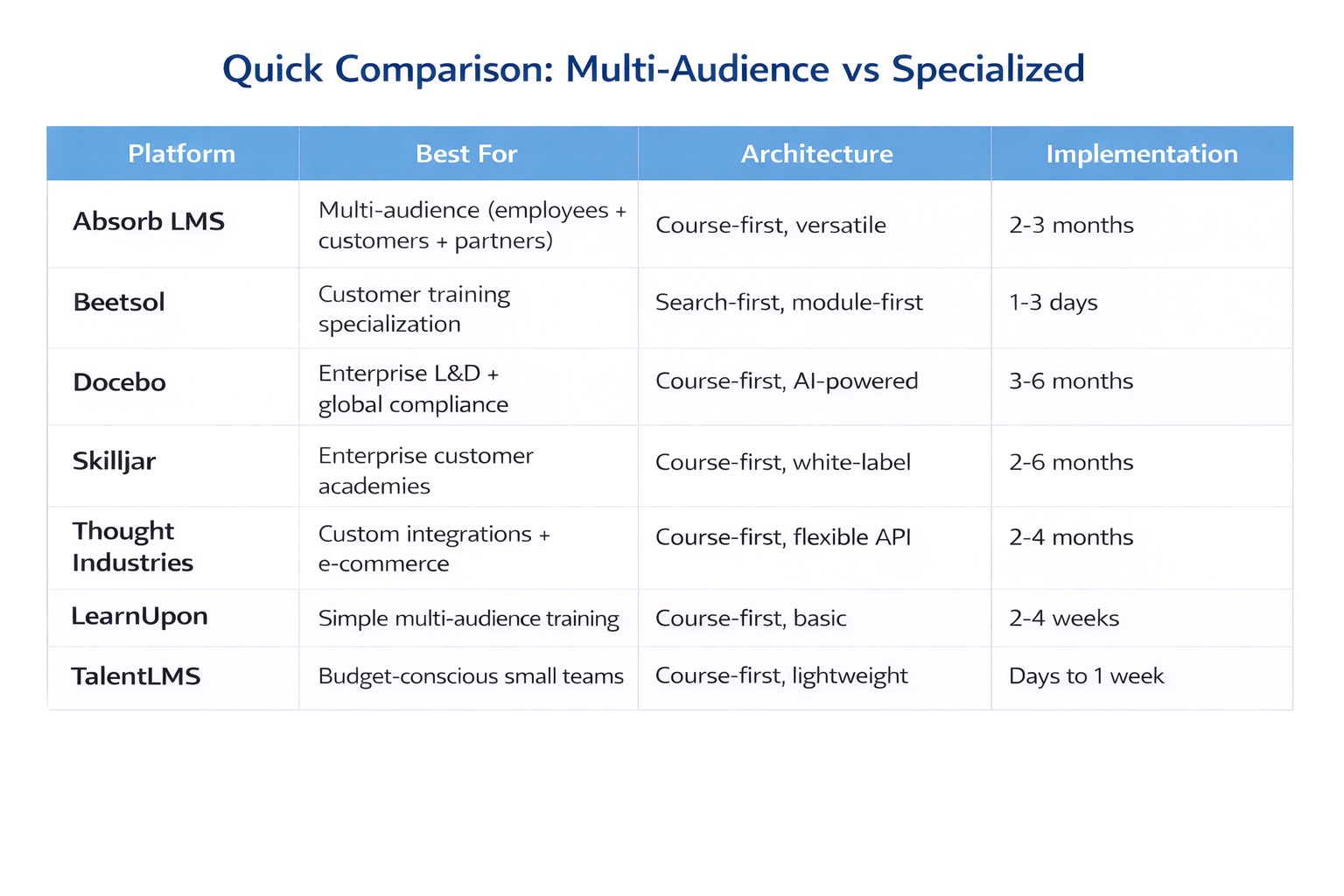
Quick Comparison: Multi-Audience vs Specialized
| Platform | Best For | Architecture | Implementation |
|---|---|---|---|
| Absorb LMS | Multi-audience (employees + customers + partners) | Course-first, versatile | 2-3 months |
| Beetsol | Customer training specialization | Search-first, module-first | 1-3 days |
| Docebo | Enterprise L&D + global compliance | Course-first, AI-powered | 3-6 months |
| Skilljar | Enterprise customer academies | Course-first, white-label | 2-6 months |
| Thought Industries | Custom integrations + e-commerce | Course-first, flexible API | 2-4 months |
| LearnUpon | Simple multi-audience training | Course-first, basic | 2-4 weeks |
| TalentLMS | Budget-conscious small teams | Course-first, lightweight | Days to 1 week |
Beetsol: The Customer Training Specialist (Not Multi-Audience, By Design)
Beetsol takes the opposite approach from Absorb. Instead of trying to serve every audience and use case, Beetsol focuses exclusively on B2B SaaS customer training — and builds architecture specifically for how voluntary learners actually behave.
Search-First, Module-First Architecture
Beetsol organizes content around the questions customers actually ask, not around courses administrators want them to complete. This module-first architecture means:
- Content exists as atomic, instantly searchable units — not trapped inside sequential courses
- Customers search, find answers in seconds, and move on
- No enrollment gates, no course navigation, no multi-step access barriers
- When structured learning is needed (onboarding, certification), those same modules can be assembled into courses or learning paths without content duplication
Example workflow comparison:
Absorb LMS (course-first):
Customer stuck on feature → Opens academy → Browses catalog → Finds relevant course → Enrolls → Module 1 → Module 2 → Module 3 → Finally gets answer (or gives up and opens support ticket)
Beetsol (search-first):
Customer stuck on feature → Types question → Gets answer → Continues working
The difference is activation speed: days vs weeks, and adoption: 60-80% vs 25%.
Built for Voluntary Learners
Employee compliance training and customer education require fundamentally different approaches. Beetsol is built for voluntary learners who:
- Search before they browse
- Need answers right now, not structured courses next week
- Won’t enroll in courses just to access one piece of information
- Value speed and convenience over comprehensive curricula
This isn’t a limitation — it’s specialization. Beetsol doesn’t try to be all things to all audiences. It excels at the one thing that matters for customer training: helping customers find answers instantly.
Implementation in Days, Not Months
Because Beetsol doesn’t require multi-audience configuration or restructuring content into courses, implementation takes 1-3 days:
- Day 1: Upload existing content (videos, PDFs, docs, SCORM — any format)
- Day 2: Configure semantic search, set up branding, integrate with your product
- Day 3: Test with internal team, launch to customers
No extensive course structuring. No multi-audience portal setup. No month-long professional services engagement. Just make content searchable and go live.
Pricing for Customer Training Specifically
Beetsol pricing reflects its specialization:
- Starter: $6,500/year (up to 100 active learners)
- Growth: $15,500/year (up to 250 active learners)
- Scale: $27,000/year (up to 500 active learners)
“Active Learners” = An active learner is anyone who logs in or searches in a calendar month, counted once no matter how often they return. Each plan includes a set number of active learners, provisioning is unlimited and free, and anyone above your plan is billed at a flat $7 per active learner per month.
For most mid-market SaaS companies, this is 30-50% less expensive than Absorb while delivering better customer training outcomes through specialized architecture.
What Beetsol Doesn’t Do (And Why That’s Good)
Beetsol deliberately doesn’t try to be Absorb:
- No multi-audience portals: If you need to train employees, customers, AND partners from one system, Absorb or Docebo are better choices
- Exhaustive employee L&D features: Limited compliance tracking, no performance reviews, no skills gap analysis
- No learning commerce: If you’re monetizing certification programs, use Thought Industries
This isn’t missing functionality — it’s focus. By not trying to serve everyone, Beetsol delivers exceptional customer training outcomes that generalist platforms can’t match.
For deeper understanding of how search-first platforms work differently than multi-audience LMS systems, see our guide on modern customer training approaches.
Migrating from Absorb LMS: What to Expect
If you decide to move from Absorb’s multi-audience platform to a customer training specialist, here’s the realistic process.
Phase 1: Audience Assessment (Week 1)
- Identify which audiences actually use Absorb (employees? customers? partners?)
- Measure current customer training adoption and usage patterns
- Export customer training content (videos, documents, SCORM, assessments)
- Determine if employee/partner training needs separate solution or isn’t being used
Key question: Are you actually using Absorb’s multi-audience capabilities, or are most portals sitting empty while you pay for infrastructure you don’t need?
Phase 2: Content Migration (Days 1-2)
- Upload customer training content to Beetsol (all formats supported)
- Configure semantic search indexing
- Set up branding to match current customer academy
- No course restructuring needed — content becomes instantly searchable
What doesn’t migrate: Multi-audience infrastructure, course hierarchies, employee L&D content. But if you’re only using Absorb for customer training anyway, these aren’t losses — they’re complexity you no longer pay for.
Phase 3: Integration Setup (Days 2-3)
- Integrate with CRM, support desk, product
- Configure SSO and user provisioning
- Test search quality with real customer questions
- Embed training widget in product or help center
Phase 4: Pilot Testing (Week 2)
- Test internally with customer success team
- Run pilot with 15-20 customers from different segments
- Compare: Can customers find answers faster in Beetsol vs Absorb?
- Measure: search success rate, time-to-answer, support ticket trends
- Optimize based on actual search patterns
Phase 5: Full Customer Training Rollout (Week 2-3)
- Announce new platform emphasizing faster, easier access
- Run both systems for 1-2 weeks (gradual transition)
- Monitor adoption: search volume, content utilization, support tickets
- Transition off Absorb customer portal after confirming Beetsol delivers results
Total timeline: 2-3 weeks for customer training (vs 2-3 months to implement Absorb initially)
What about employee/partner training? If you’re actually using Absorb for employees or partners, you’ll need separate solutions or decide if that training is valuable enough to keep Absorb just for those audiences. Often, companies discover they were paying for multi-audience infrastructure but only really using customer training — the other portals sat mostly empty.
Cost-Benefit Analysis
Staying with Absorb:
- Continue paying $20K-$50K annually
- Keep 25% customer training adoption plateau
- Maintain complexity of multi-audience infrastructure
- Support tickets remain high for documented features
Switching to specialized platform:
- 30-50% lower annual cost ($6.5K-$27K)
- 60-80% customer training adoption (3-4x improvement)
- Eliminate multi-audience complexity
- Support tickets drop 30-40% within 60 days
- Customer activation accelerates (days instead of weeks)
The ROI calculation favors specialization when customer training is your primary mandate. See the ROI Calculator →
Common Objections to Switching
“We use Absorb for multiple audiences. What about employee/partner training?”
First, check actual usage. Many companies pay for multi-audience platforms but discover only customer training sees real adoption. Employee portals often sit mostly empty.
If you actually use employee training:
- Keep Absorb for employee L&D, move customer training to Beetsol (each platform does what it’s best at)
- Or migrate employees to simpler tool like BambooHR Learning or Trainual (often cheaper and easier than Absorb for internal use)
- Or reconsider if mandatory employee courses are delivering value vs checking compliance boxes
The key question: Is multi-audience consolidation actually saving you money and complexity, or costing you in both?
“The implementation cost is already sunk.”
Sunk cost fallacy. The question isn’t “How much have we spent?” but “What’s the ROI going forward?”
If Absorb isn’t delivering results for customer training specifically, continuing to pay for multi-audience infrastructure you don’t fully use doesn’t honor past investment — it compounds the loss.
“We’ve customized Absorb heavily for our workflow.”
Ask: Are those customizations delivering outcomes, or just complexity?
Many Absorb customizations exist to work around course-first limitations (custom search, navigation shortcuts, content organization). In search-first platforms, these workarounds become unnecessary — the architecture solves the problem natively.
“Simpler platforms sound risky.”
Run a pilot. Test Beetsol with your actual content and real customers for 30 days. Measure:
- Can customers find answers faster?
- Do support tickets decrease?
- Is content utilization higher?
Data removes risk better than debates about features or architecture.
FAQ
Can Beetsol replace Absorb completely?
For customer training specifically: yes. Beetsol handles customer onboarding, feature training, and support deflection better than multi-audience platforms optimized for breadth over depth.
For multi-audience training (employees, customers, AND partners all actively using it): no. If you genuinely need to train all three audiences from one system, Absorb remains necessary.
How long does migration take?
Audience assessment: 3-5 days
Content export and upload: 1-2 days
Platform configuration: 1 day
Testing and pilot: 1 week
Full rollout: 3-5 days
Total: 2-3 weeks for customer training migration
What happens to our existing Absorb content?
All customer training content migrates: videos, PDFs, SCORM files, presentations, documents. Beetsol auto-indexes and makes it searchable. No reformatting required.
What doesn’t migrate: Course structures, multi-audience configurations, employee/partner content (unless you want it to). But if those weren’t being used anyway, that’s not a loss.
Do we lose course structure entirely?
No. Beetsol supports courses and structured learning paths for customers who want guided onboarding or certification programs. The difference: customers aren’t forced into courses to access information. They can search and find specific answers OR follow structured paths. Both work with the same content.
What about analytics and reporting?
Beetsol tracks what matters for customer training:
- Search queries (what customers look for)
- Search gaps (what they search for but can’t find)
- Content utilization by topic
- Time-to-answer metrics
- Correlation with feature adoption
This is more actionable than course completion rates across multiple audiences.
How do we know if we’re a “versatility” company or a “specialization” company?
Ask these questions:
- How many audiences actively use training? If only customers use it regularly, you don’t need multi-audience.
- What’s your primary training mandate? Customer activation and support deflection? Or compliance and skills development across multiple groups?
- Who manages the platform? If it’s not dedicated L&D team, you likely need customer training specialization.
- What outcomes matter most? Faster customer activation? Or comprehensive employee development programs?
If customer training is your primary mandate, specialized platforms deliver better outcomes even if you sacrifice multi-audience versatility you weren’t really using anyway.
Can we run a side-by-side comparison before switching?
Yes, and you should. Run a 30 day pilot:
- Upload same customer training content to both Absorb and Beetsol
- Split your customer base: 50% see Absorb portal, 50% see Beetsol
- Track identical metrics for both groups: time-to-answer, content utilization, support tickets, activation speed
- Compare: Which platform delivers better customer outcomes?
This removes guesswork. Let real customer behavior and real business metrics show which architecture works better for your specific use case.
Most companies discover that multi-audience versatility looks good on feature comparison charts but specialized architecture delivers better real-world results for customer training specifically.
Next Steps
If Absorb’s multi-audience approach feels like overkill for customer training, you have options.
Start with these questions:
- What percentage of Absorb’s audiences actually use it? (If only customer training, you’re overpaying for infrastructure)
- What’s our customer training adoption rate? (If under 40%, the architecture isn’t working)
- How many support tickets are about features covered in training? (If over 30%, training isn’t findable)
- Could we achieve better customer outcomes with specialized tools? (Honest answer matters)
For comprehensive guidance on building effective customer training programs, see our customer training LMS strategy guide.
Then:
- Request a Beetsol pilot with your actual customer training content
- Run it alongside Absorb for 30 days with real customers
- Compare outcomes: findability, utilization, activation speed, support tickets
- Choose based on data, not feature counts or vendor promises
The right platform isn’t the one that can do everything — it’s the one that excels at what actually matters for your specific use case.
See how Beetsol’s Customer Training Architecture works →