You chose the platform because you wanted your customers to succeed. The vendor demo was compelling — branded academy, structured learning paths, AI-powered recommendations, completion tracking. It looked like exactly what your customers needed.
What nobody showed you was what happens after go-live.
- The third-party implementation partner.
- The 10-20 hours a week your enablement team spends maintaining course structures instead of improving customer outcomes.
- The annual uplift that raises the price inside a contract you can’t exit.
The Year 3 renewal where someone asks “is this actually working?” and nobody has a clean answer — because the LMS tracks enrollments and completions, but the business outcomes it was supposed to drive are owned by CS, product, and support collectively. The platform can’t isolate its own contribution.
So the conversation shifts to what it can show: 1,200 enrollments, 340 completions, and a branded academy that looks professional. It renews — not because the data supports it, but because switching feels like a bigger risk than staying.
That’s the real cost of customer training software. Not the subscription. The organizational burden it creates and the ROI question it can never answer.
This guide breaks it all down — so the next decision is made with full visibility.
This guide focuses on pricing and total cost of ownership. For a feature comparison and a full top-10 ranking, see our Best Customer Training Software for B2B SaaS.
How the Cost Actually Accumulates
Months 1-2: The Buying Cycle. Pricing is quote-based for most platforms. You spend 2-3 months in discovery calls and proposal reviews just to get comparable numbers. During this process, you’re asked to commit to a user tier — but you don’t know how many active learners you’ll have. So you buy the upper tier to be safe, paying a per-user cost from day one for capacity you may never use. Most enterprise contracts are 3 years with no exit clause. You’re locked in before a single customer has logged in.
Months 3-8: The Implementation Project. The vendor recommends a third-party implementation partner. The partner quotes $15,000-$50,000 plus ongoing maintenance. Your enablement team — the people you hired to drive customer outcomes — spend 100-300 hours over the next 3-6 months coordinating between the vendor, the partner, and your engineering team. The partner manages their scope. The vendor manages their platform. Your team manages everything in between. This becomes their primary project, meanwhile, customers who needed help during this window have already churned or flooded your support queue.
Month 9: Go-Live. The academy launches. Branded, structured, professional. Your enablement team feels relief. The project is done.
Months 10-12: The First Anniversary Uplift. Except the project is never done — and neither is the pricing. The subscription almost always increases at each contract anniversary, not just at renewal. Year 1’s $40K becomes $43K. And now you’re seeing real utilization data for the first time. Half your “active learners” logged in once during onboarding and never returned. You’re paying for a tier based on projected users, not actual ones — and there’s no mechanism to step down mid-contract.
This connects to a broader shift across SaaS: the era of paying for provisioned seats that sit empty is ending. As we explored in our usage-based enablement analysis, billing models that charge for potential rather than actual usage create misaligned incentives — the vendor gets paid whether your customers engage or not.
Months 12-30: The Quiet Accumulation. Your enablement or L&D lead now spends 15 hours per week maintaining the platform. Rebuilding modules when the product ships new features. Managing user provisioning. Pulling reports for leadership. Troubleshooting broken integrations instead of analyzing why customers churn at Month 6. This was supposed to be a tool that freed their time. Instead, it consumed it. But because the hours are absorbed into their job description rather than tracked as a line item, the cost stays invisible.
The annual uplift hits again at the Year 2 anniversary. The subscription is now $46.6K. You’ve paid over $130k in subscription alone and you’re still 6 months from any option to leave.
At this point you realize the support ticket volume hasn’t changed. The 40-60% that are how-to questions about documented features? Still flowing. The academy exists — customers just aren’t using it. For why this happens and what fixes it, see How to Reduce Support Tickets Through Customer Training.
Month 36: The Renewal. Three years in. This is your first real decision point. The vendor knows this, so the renewal conversation starts at Month 30.
Here’s the structural problem that makes ROI unanswerable: the enablement team owns the platform, while CS owns the customer outcomes. Ticket reduction, activation speed, and churn are influenced by product, support, CS, and enablement collectively. The LMS can’t isolate its contribution. So the QBR defaults to what the platform can report — enrollment counts, completion rates, academy design — rather than the business outcomes it was supposed to drive.
The renewal offer comes in 10-15% above Year 3’s already-escalated price. Your enablement team, who championed the original purchase and invested hundreds of hours building the academy, faces an uncomfortable truth: recommending a switch feels like admitting the decision was wrong. Renewing feels safer, even if the numbers don’t support it. The platform renews.
For a deeper analysis of why adoption plateaus at 20-25% regardless of content quality, see Why Your Customer Training Academy Has 25% Adoption.
This Isn’t a Failure of People
The enablement team that chose the platform made a reasonable decision with the information available. Enterprise platforms look like the right answer during evaluation — they have the features, the brand names, the customer logos. The problem only becomes visible 12-18 months in, when the maintenance burden is real and the adoption numbers aren’t moving.
The issue isn’t the decision. It’s the architecture. Course-first platforms require content to be structured before it’s accessible. That structuring demands implementation. That implementation demands coordination. And once structured, the content requires ongoing maintenance every time the product changes. The burden isn’t a bug — it’s how the architecture works.
The question for 2026 is whether customer enablement should still demand this from the teams responsible for it.
For a deeper look at why course-first architecture creates this burden structurally — and how search-first architecture eliminates it — AI promise vs. reality manifesto.
The Alternative: Platforms That Don’t Need Projects
Search-first platforms eliminate the implementation project. Upload existing content — PDFs, videos, SCORM files, docs — and it’s accessible immediately. No restructuring into courses. No third-party partners. No 6-month timelines. Your enablement team spends their time on strategy, not platform administration.
We built Beetsol this way. We publish all pricing publicly because there’s nothing hidden to discover later. The subscription is the cost.
Pricing Models: Four Approaches
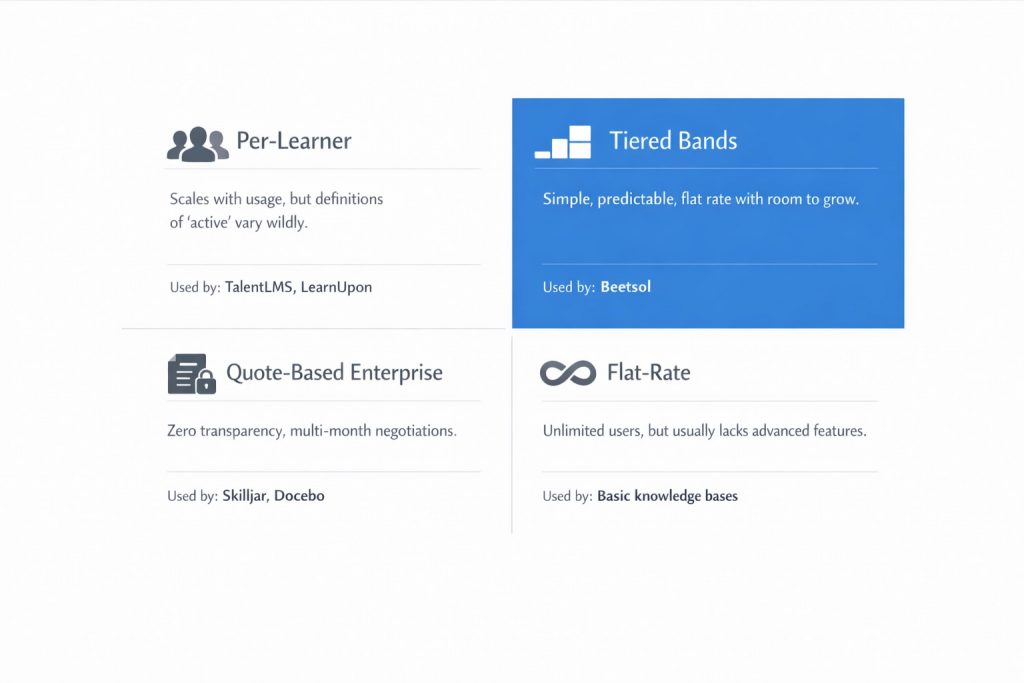
Per-Learner Pricing ($5-15/active learner/month). Used by TalentLMS, LearnUpon. Scales with usage, but “active learner” definitions vary significantly between vendors — some count anyone who logs in, some count anyone with an account whether active or not, some count monthly active users. The same customer base can produce wildly different learner counts depending on definition. Get it in writing before evaluating any quote.
Tiered Pricing (fixed bands). Used by Beetsol. Simple, predictable, published publicly. You know your cost before your first sales call. Room to grow within your tier without monthly bill changes. Watch for jump costs at tier boundaries — know your growth trajectory.
Quote-Based Enterprise (custom). Used by Skilljar, Docebo, Thought Industries. Flexible for very large buyers with negotiation leverage. But zero transparency until you’re weeks into the sales cycle, and two identical companies can pay drastically different amounts depending on timing and negotiation skill. Budget planning is impossible until deep in the process.
Flat-Rate ($299-499/month unlimited). Used by basic LMS tools and some knowledge base platforms. Ultimate simplicity, but usually signals limited features and lack of depth.
One Distinction That Saves You Money
In B2B SaaS, there is a massive difference between a provisioned seat and an actual learner. If you have 200 customer accounts, but only 2 admins from each ever use your training, your true audience is 400 people. Legacy vendors blur this line, padding your quote with the 2,000 potential users sitting in your CRM. Never accept a contract that bills for provisioned seats instead of actual logins. Even if the vendor’s active-user tier carries a higher per-seat premium, paying for 400 people who actually use the platform will always cost less than subsidizing a platform for 2,000 people who don’t.
What You’ll Actually Pay: Platform by Platform
Beetsol — Search-First Model
Starter: $6,500/year (up to 100 active learners)
Growth: $15,500/year (up to 250 active learners)
Scale: $27,000/year (up to 500 active learners)
“Active learners” = An active learner is anyone who logs in or searches in a calendar month, counted once no matter how often they return. Each plan includes a set number of active learners, provisioning is unlimited and free, and anyone above your plan is billed at a flat $7 per active learner per month.
All features included. No paying for idle seats. No implementation partner needed. Live in days.
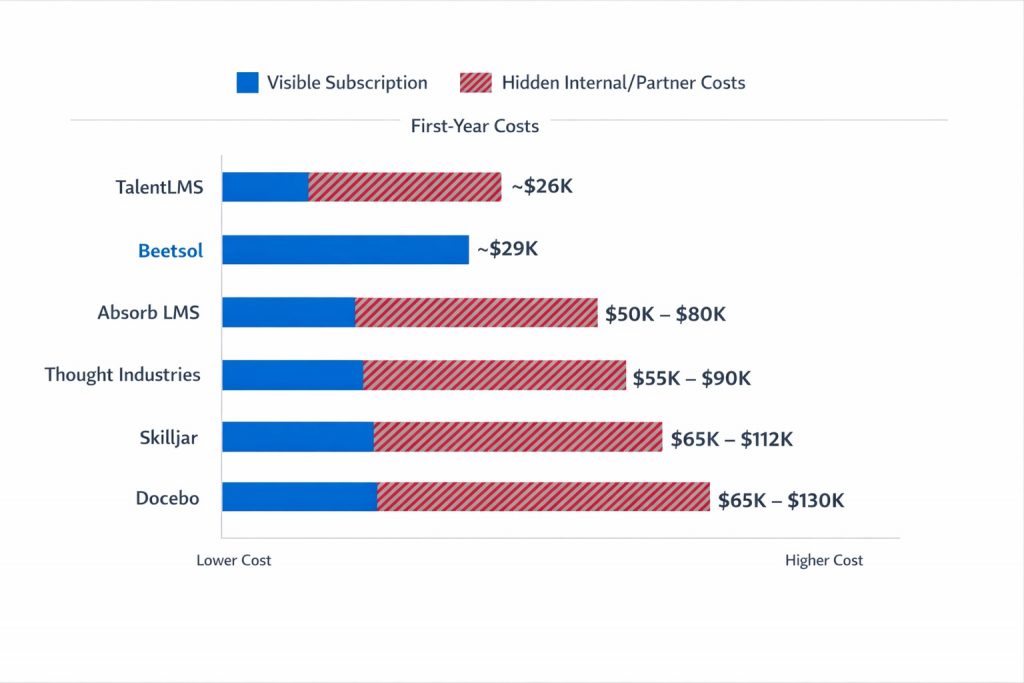
Total first-year cost (200 customers): ~$29K including internal setup time. View pricing →
Skilljar — Enterprise Model
Subscription: $30K-$50K/yr (mid-market), $60K-$150K+ (enterprise). Not published.
Add: implementation partner ($10-30K), integrations ($5-20K each), premium support (10-20% of license), internal coordination (150+ hours during implementation), ongoing admin (15 hrs/week indefinitely).
Total first-year cost (200 customers): $65-$112K including internal time.
Docebo — Enterprise Model
Subscription: $25K-$60K/yr (mid-market), $80K-$200K+ (enterprise). Not published.
Add: implementation ($15-40K), customization ($10-50K), annual maintenance (18-22% of license), comparable internal burden to Skilljar.
Total first-year cost (200 customers): $65-$130K.
Thought Industries — Mid-Enterprise
Subscription: $25K-$40K/yr (mid-market). Not published.
Add: implementation ($8-25K), custom development ($100-150/hr), premium support (15-20% additional).
Total first-year cost (200 customers): $55-$90K.
TalentLMS — Budget Model
Published: $69-$489/month depending on subscription tiers.
Total first-year cost (200 customers): ~$26K including internal time.
Low subscription but features differ per tier. Course-based architecture still creates admin burden (5 hrs/wk). Limited search means lower customer utilization.
LearnUpon & Absorb LMS
LearnUpon: Starts at $599/month. Implementation $2-5K additional. Total first-year cost: $17K-$30K.
Absorb LMS: Subscription: $20K-$50K/yr. Implementation and integrations add 30-50%. Total first-year cost: $50-$80K.
For detailed platform reviews including features, architecture, and ideal company size, see our Top 10 Customer Training Software comparison.
The Costs That Never Appear on an Invoice
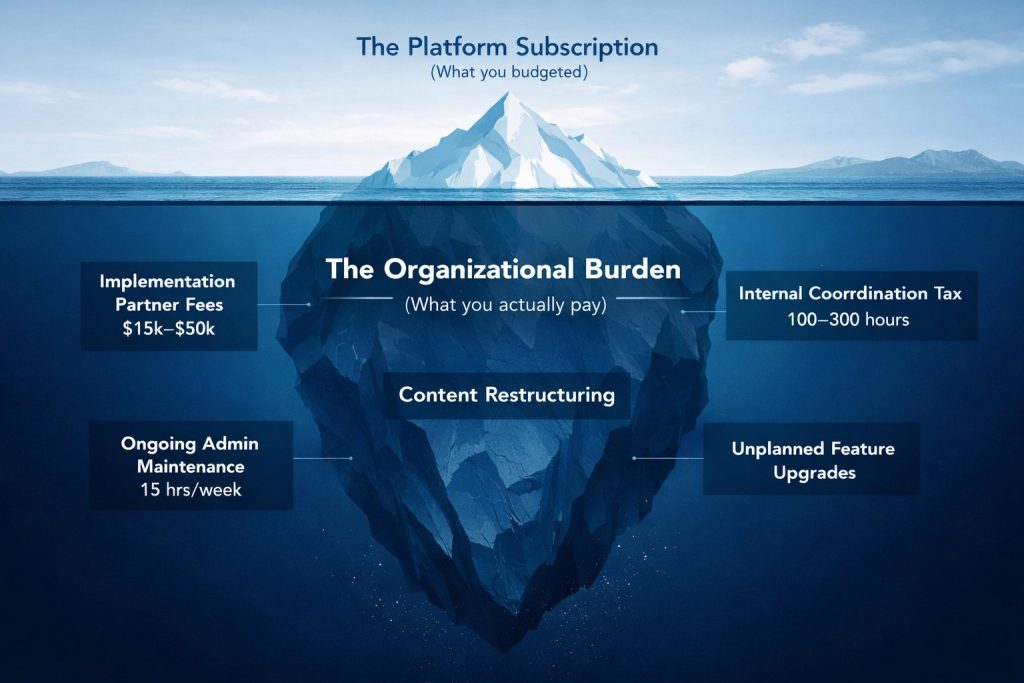
The subscription is the visible part. Here’s everything below the surface:
- The Implementation Project. Partner fee: $10-50K. Your team’s time coordinating: 100-300 hours over 3-6 months. Total implementation cost is often 2-3x the partner’s invoice alone because nobody accounts for the internal coordination burden.
- Content Restructuring. Course-based platforms require restructuring your docs, videos, SCORM, and PDFs into course-module-lesson format. Cost: $5-15K in partner fees or 40-80 hours internally. Search-first platforms skip this entirely.
- Integration Development. Custom workflow integrations (CRM, product telemetry) usually cost $5-20K each.
- Ongoing Administration. The cost that compounds fastest. Updating structures, rebuilding modules, managing access, pulling reports. At 15 hours/week and $75/hour, that’s $58,500/year.
Over a 3-year contract: $175,000 — more than the subscription itself. This is your enablement team’s time spent on platform maintenance instead of customer outcomes.
- Contract Escalation. Annual uplifts of 5-10% compound inside a 3-year lock-in with no exit. A $40K Year 1 contract becomes $46.6K by Year 3. Total subscription over the term: $126K+ before touching internal time. And the first time you can actually renegotiate is Month 36.
3-Year Total Cost of Ownership
| Cost Category | Enterprise (Skilljar) | Search-First (Beetsol) |
|---|---|---|
| 3-Year Subscription | $126,000 | $46,500 |
| Implementation + Partner | $35,000 | $0 |
| Internal Time (3 years) | $175,000+ | $36,000 |
| 3-Year Total | ~$336,000 | ~$83,000 |
| Weekly Admin Burden | 15 hrs/wk | 2-3 hrs/wk |
The $253K gap between enterprise and search-first isn’t mostly subscription difference. It’s internal time — your enablement team gets back 12+ hours per week to spend on customer outcomes instead of platform maintenance.
How to Calculate Whether It’s Worth It
If your primary goal is faster activation or higher adoption rather than ticket reduction, the ROI case is even stronger — it’s just harder to put a precise dollar figure on. The calculation below uses support tickets because it’s the most auditable metric available, but the business case extends well beyond it.
Quantify the problem. Tickets/month × % about documented features (typically 40%) × cost per ticket ($15-25) = monthly waste. Example: 800 × 40% × $20 = $6,400/month = $76,800/year on questions your documentation already covers.
Estimate impact of training on documented feature tickets. A conservative 30% reduction on that $76,800 = $23,040/yr saved. Moderate 35% = $26,880/yr. Optimistic 40% = $30,720/yr.
Compare those savings against true cost — not just subscription.
- Beetsol Year 1: $26,880 (Moderate 35% reduction) in ticket savings against $29K true cost (subscription + internal time) = roughly break-even. Strongly positive Year 2+ as content matures and ticket reduction compounds.
- Enterprise Year 1: The same $26,880 in savings against $112K true cost = -$85K. Doesn’t break even until deep into Year 3 — and that assumes the reduction actually materializes through a platform sitting at 20% adoption.
Ticket reduction is the easiest number to calculate, but not the only value. Faster customer activation, support teams redirected from repetitive questions to expansion work, and feature adoption driven by searchable training all compound on top of the direct savings.
Set baselines before you buy — not after. Document ticket volume by topic, time-to-first-value, and current training utilization. Measure the same numbers at 90 days. This is what proves ROI at the Year 1 QBR with data, not enrollment metrics.
For the full ROI framework including how to connect training metrics to business outcomes, see Customer Training ROI: The Metrics That Actually Reduce Churn.
Use Beetsol’s ROI calculator to estimate your specific numbers.
Negotiation Strategies (For Quote-Based Platforms)
If you’re choosing an enterprise platform, here’s how to negotiate without getting taken:
- Get Competing Quotes. Quotes from 3 vendors. Share ranges during negotiations: “Vendor X quoted $30-35K for our size. Is that consistent?” Result: 15-25% better pricing through competitive pressure.
- Ask for Itemized Pricing. Request a full breakdown — platform, implementation, support, and add-ons as separate line items. This reveals where costs are inflated and gives you specific items to push back on.
- Challenge the Implementation Requirement. Ask: “What’s the platform-only price if we handle implementation internally?” Even if you ultimately use a partner, this reveals how much of the cost is architectural necessity versus vendor preference.
- Ask About Internal Admin Burden. “How many hours per week do your mid-market customers spend managing the platform?” If the answer is vague or over 5 hours, multiply by your hourly cost and add it to the TCO. This is the number nobody volunteers.
- Leverage Timing. End of quarter (especially Q4) and end of fiscal year are when sales teams need to hit quota. 10-20% better pricing during these windows without asking.
- Always Negotiate an Exit Clause. Most enterprise contracts default to 3 years, no exit. Push for a 12-month performance clause: if utilization falls below an agreed threshold (e.g., 30% active learner rate), you can exit without penalty. If the vendor won’t offer this, ask yourself why they need to lock you in for 3 years to keep you.
- Never Multi-Year on a First Contract. Prove value in Year 1 with data. Then negotiate multi-year at renewal from a position of evidence — not hope.
4 Red Flags During Price Discussions
Pricing Red Flags to Watch For
“We need to understand your budget first.”
The price will be based on what you can afford, not what the software costs. Response: Ask for standard pricing at your company size first.
Implementation costs that rival the subscription.
If deploying a $30K platform requires a $25K partner plus 200 hours of your team’s time — that’s architectural complexity you’ll be paying for every year in admin burden. If the vendor says “most customers work with an implementation partner,” treat the partner fee plus your internal coordination time as a mandatory cost, not an optional service.
3-year contract with compounding annual increases and no exit clause.
An 8% annual increase on a $40K contract becomes $54K by Year 4. You’re locked in for 36 months with the price rising at each anniversary and no option to leave if adoption is at 20% after 12 months. Always negotiate flat pricing or CPI-indexed increases, and push for an exit clause tied to a utilization threshold.
“Advanced analytics available at higher tiers.”
Vague feature gating is a trap. Ask explicitly: “What specifically is NOT included at my tier?” and get the answer in writing before signing.
FAQ
Why don’t most vendors publish pricing?
Three reasons: price discrimination (charge each buyer whatever they’ll accept), competitive concealment (make apples-to-apples comparison difficult), and the upsell runway — get a foot in the door with a reasonable platform number, then add implementation services, premium support, and feature upgrades that double the Year 1 cost. Vendors who publish pricing are confident enough in their value to let you evaluate before talking to sales.
What’s a reasonable budget for a mid-market company (100-500 customers)?
Budget-conscious: $5-10K/year subscription. Mid-range: $15-30K/year. Enterprise features: $40-60K/year. But always add 50-100% for internal time and implementation when budgeting enterprise platforms. The subscription is never the full cost.
When should I choose an expensive enterprise platform?
Legitimate reasons exist. If you need 40+ languages for global compliance, complex organizational hierarchies across regions, formal certification programs generating revenue, or deep audit trails for regulated industries — enterprise platforms are built for that complexity and the price reflects it. If your goal is helping B2B SaaS customers find answers and stop opening tickets for documented features, enterprise complexity creates organizational burden without proportional return.
Should I pay monthly or annually?
Start monthly for 3 months. Prove adoption is real and outcomes are tracking. Switch to annual for 15-25% savings. Never commit to annual on a first contract without evidence it’s working for your specific customers.
What about free or open-source options?
Free tiers are fine for testing, insufficient for production. Open-source (Moodle) has $0 licensing but real costs: hosting ($50-500/month), development (10-40 hours/month), and ongoing technical debt. Total cost often exceeds commercial options — and the admin burden is the highest of any option because you own the infrastructure.
How does Beetsol compare to competitors for the same customer count?
For a 200-customer SaaS company:
What if I’m locked into an expensive contract?
At renewal: get competing quotes, negotiate 20-30% off. Mid-contract: document low utilization, request a tier downgrade, or invoke exit clauses. Most vendors would rather renegotiate than lose you.
Where can I compare features alongside pricing?
See our Best Customer Training Software for B2B SaaS guide for a full comparison across findability, architecture, implementation speed, and ideal company size.
Making Your Decision
Calculate the true cost — not just the subscription. For every platform you evaluate: subscription + implementation partner + internal coordination time + ongoing admin (hours/week × 52 × hourly cost) = real annual cost. If a vendor can’t help you calculate this number in one conversation, that tells you something about what they’re not showing you.
Set baselines before you buy. Ticket volume by topic. Time-to-first-value. Current training utilization. Support team time allocation. These are the numbers that prove ROI at the Year 1 QBR — not enrollment counts, not completion rates, not how the academy looks.
Choose on total ROI, not subscription price. A $16K platform with 3 hrs/week admin that reduces tickets 35% beats a $40K platform with 15 hrs/week admin that can’t prove the same impact. The subscription is one input. The organizational burden is the other. Both determine whether the investment was worth it.
If your enablement team is spending more time managing the platform than improving the outcomes it was supposed to deliver — the architecture is the problem.
The right platform makes your customers more self-sufficient AND makes your team’s life easier. If it only does the first, the TCO will eventually kill the ROI.
View Beetsol’s pricing · Request a demo