What this guide covers
Where LearnUpon works well, where it breaks down for B2B SaaS customer training, and when a search-first alternative like Beetsol is the better architectural fit. If you’re evaluating other platforms, see our comparisons of Docebo, Skilljar, Thought Industries, Absorb LMS, and TalentLMS.
For broader context on modern customer training strategies, see our complete customer training LMS guide.
LearnUpon occupies a specific niche in the LMS market: it’s more capable than budget tools like TalentLMS, less overwhelming than enterprise platforms like Docebo or Skilljar, and faster to implement than most mid-market alternatives. For companies that need clean course delivery across employees, customers, and partners without enterprise complexity, it’s a reasonable choice.
But there’s a gap between what LearnUpon was designed for and what B2B SaaS customer training specifically requires.
LearnUpon is a course-first platform built for structured, multi-audience training. It assumes learners will browse course catalogs, enroll in programs, and follow sequential paths. That assumption holds for employees completing mandatory onboarding or partners working through certification requirements. It breaks for B2B SaaS customers — voluntary learners who arrive with a specific problem, need an immediate answer, and will open a support ticket (or stop using your product) if they don’t find one in 30 seconds.
When to choose LearnUpon over Beetsol: If you need one platform for employees, customers, and partners with clean multi-portal support, and structured course delivery is your primary model. LearnUpon excels as a mid-market multi-audience LMS with faster implementation than enterprise alternatives and a polished learner experience.
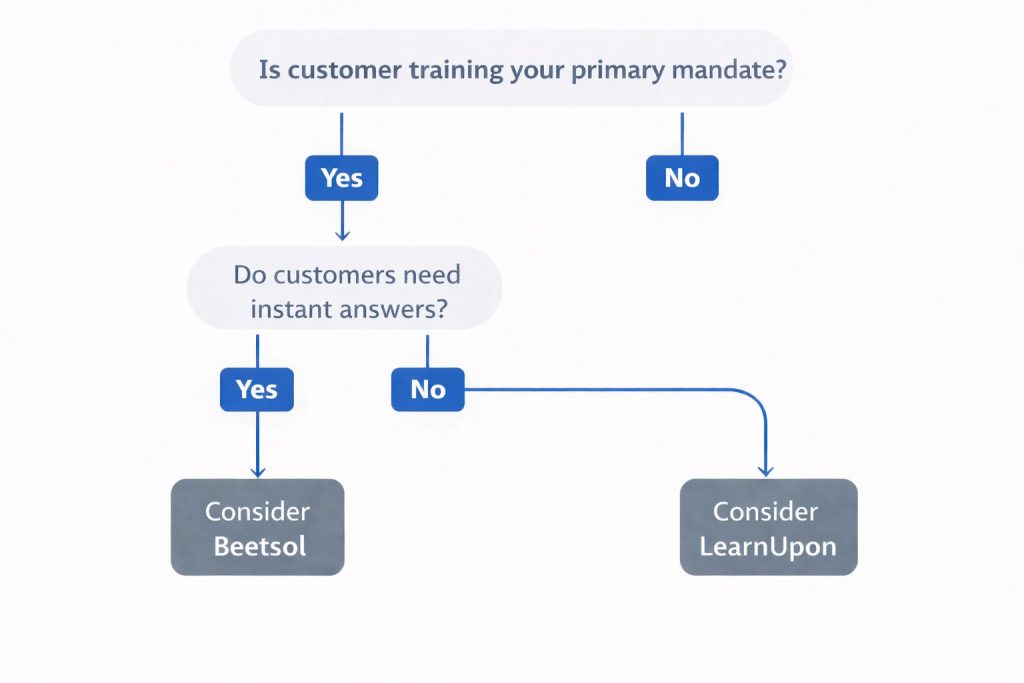
When to choose Beetsol over LearnUpon: If your primary mandate is B2B SaaS customer training and you need customers to find answers instantly without navigating course structures. LearnUpon treats customer training as one more course portal — same architecture as employee compliance. If you need customers to activate in days, find answers through natural language search, and you want to see exactly what customers search for but can’t find, Beetsol’s search-first architecture delivers 60-80% adoption vs the 25% plateau typical of course-based systems.
What LearnUpon Does Well
Before discussing alternatives, LearnUpon has earned its market position for legitimate reasons. It represents a deliberate middle ground — more polished than budget tools, less complex than enterprise platforms — and for its core use case, the value proposition is real.
Clean Multi-Portal Support
LearnUpon’s strongest differentiator is multi-portal management. Create separate branded learning portals for different audiences — employees, customers, partners — each with their own content library, branding, and user management, all controlled from one admin dashboard. For companies genuinely training multiple audiences, this consolidation reduces the overhead of managing separate platforms.
Faster Implementation Than Enterprise LMS
LearnUpon implementations typically take 2-4 weeks — significantly faster than Docebo (3-6 months), Skilljar (2-6 months), or Absorb (2-3 months). For companies that can’t wait quarters to launch training, this speed matters. The platform’s relatively straightforward configuration means less professional services overhead.
Polished Learner Experience
The learner interface is consistently praised across review platforms. Course navigation is intuitive, learning paths are well-structured, and the overall UX is cleaner than most mid-market competitors. Gamification features — badges, leaderboards — add engagement for audiences that respond to completion incentives.
AI Content Creation
LearnUpon has added AI-powered course creation, including content generation, exam creation, and scenario-based learning. These tools accelerate content authoring for teams building new courses. The AI features are more accessible than Docebo’s enterprise-grade AI and less restricted than TalentLMS’s tier-gated approach.
Solid Integration Ecosystem
Integrations with major CRMs, HRIS platforms, and Zapier cover standard training workflows. Two-way API access on higher tiers enables custom automation. SCORM, xAPI, and AICC support ensures content portability.
How Customer Training Specialization Delivers Different Outcomes
Based on aggregate data from B2B SaaS companies migrating from course-first platforms to Beetsol’s search-first architecture, here is the typical delta:
These outcomes are enabled by customer training specialization — not by using a cleaner course platform. See the detailed breakdown with technical capabilities →
Where LearnUpon Falls Short for Customer Training
LearnUpon’s mid-market positioning and clean UX create an impression that it should work well for customer training. The reality is more nuanced — the platform’s course-first architecture creates the same structural limitations that affect all traditional LMS platforms when applied to voluntary learners.
1. Course-First Architecture for Voluntary Learners
The problem: LearnUpon organizes everything around courses, learning paths, and portals. Customers must navigate to the right portal, find the right course, enroll, and progress through modules to access specific information. This works when learners have time and motivation — employees in mandatory training, partners in certification programs. It fails for B2B SaaS customers who arrive with one question and need one answer.
Why it matters: This mandatory-vs-voluntary distinction is the root cause of the 25% adoption plateau that affects every course-based LMS applied to customer education. A cleaner UI doesn’t fix an architectural mismatch. The downstream cost: 40-60% of your support queue stays filled with how-to questions about features your training already covers. For the complete breakdown of what that category costs and how to eliminate it, see How to Reduce Support Tickets Through Customer Training.
2. No Semantic Search
The problem: LearnUpon’s search is keyword-based and returns courses, not answers. When a customer searches “how do I let someone access my project,” the platform looks for keyword matches in course titles and descriptions. If the relevant content is inside a course titled “Role-Based Access Control and Team Permissions,” keyword search sees zero overlap.
Why it matters: Customers and product teams use different language. Without semantic search that understands intent, customers can’t find training that exists. This isn’t a missing feature — it’s a fundamental gap in how the platform connects customers to content. See our guide for deeper analysis of why course-first platforms consistently underperform for customer training.
3. No Content Gap Detection
The problem: LearnUpon analytics track course completions, learner progress, and engagement metrics. What they don’t track is what customers searched for and couldn’t find — the zero-result queries that represent unmet customer needs.
Why it matters: Zero-result search gap detection is arguably the most valuable analytics capability for customer training. When 50 customers search “bulk import contacts” and get nothing, that’s a product signal — a training module waiting to be created, a support ticket waiting to be prevented. LearnUpon has no mechanism to surface this intelligence because its analytics were designed around course completion, not search intent resolution.
4. Separate Portals Create Context-Switching
The problem: LearnUpon training lives in separate branded portals. Even with SSO, customers must leave your product, navigate to the portal, find the right course, and locate the right lesson within it.
Why it matters: Every context switch kills engagement. A customer stuck inside your product needs an answer right there — not a portal in another tab. Opening a support ticket takes 15 seconds. Navigating to a portal, finding a course, and locating the right module takes 60+ seconds. The math favors the ticket every time. Embedded delivery eliminates this entirely.
5. Quote-Based Pricing Obscures True Cost
The problem: LearnUpon doesn’t publish pricing. Industry estimates place it at $6-9/user/month, with minimum annual contracts around $10,000-$15,000. At 200 users, you’re looking at roughly $16,800/year. At 500 users, approximately $36,000-$54,000/year. But you won’t know your actual cost until weeks into the sales cycle.
Why it matters: Quote-based pricing adds 2-3 months to your buying cycle and makes ROI planning impossible before you’ve committed significant evaluation time. Meanwhile, Beetsol publishes all pricing publicly — $6,500/$15,500/$27,000 per year, all features included at every tier, active-learner billing only. You can calculate ROI before your first conversation. For the full cost comparison across all major platforms including hidden implementation fees, see our Customer Training Pricing Guide.
Who Should Consider LearnUpon Alternatives
You’re likely a good fit for alternatives if:
Customer training is your primary mandate (not employee L&D or partner certification), your customers need instant answers rather than structured courses, you need capabilities LearnUpon doesn’t offer (semantic search, content gap analytics, embedded delivery), or your academy adoption is under 30% despite having content.
Stick with LearnUpon if:
You genuinely train multiple audiences (employees, customers, and partners) and all portals see real engagement, structured course delivery with completion tracking is your primary model, or you need a mid-market platform that’s simpler than Docebo but more capable than TalentLMS for multi-audience use cases.
Other LearnUpon Alternatives to Consider
Beyond Beetsol, several platforms serve as LearnUpon alternatives. We’ve written detailed comparison guides for each — here’s the summary.
Skilljar ($30K-$150K+/year) — Enterprise customer academies with white-label portals. Course-first, 2-6 month implementation. Full comparison →
Docebo ($25K-$200K+/year) — Enterprise AI-powered L&D with 40+ languages and learning commerce. 3-6 month implementation. Full comparison →
Absorb LMS ($20K-$50K/year) — Multi-audience training (employees, customers, partners) from one platform. Course-first, 2-3 month implementation. Full comparison →
Thought Industries ($25K-$40K/year) — Strong API and native e-commerce for monetizing training. 2-4 month implementation. Full comparison →
TalentLMS ($119-$779/month) — Budget employee training for small teams. Days to 1 week implementation. Full comparison →
Beetsol ($6,500-$27,000/year) — Search-first, module-first architecture built specifically for B2B SaaS customer training. 1-3 day implementation.
For the complete top-10 comparison with detailed analysis of each platform, see Best Customer Training Software for B2B SaaS (2026).
Quick Comparison
| Platform | Best For | Pricing | Implementation |
|---|---|---|---|
| LearnUpon | Mid-market multi-audience training | ~$10K-$50K+/yr (quote-based) | 2-4 weeks |
| Beetsol | B2B SaaS customer training | $6.5K-$27K/yr | 1-3 days |
| TalentLMS | Budget employee training, small teams | $119-$779/mo | Days to 1 week |
| Absorb LMS | Multi-audience (employees + customers + partners) | $20K-$50K/yr | 2-3 months |
| Thought Industries | Custom integrations + e-commerce | $25K-$40K/yr | 2-4 months |
| Skilljar | Enterprise customer academies | $30K-$150K+/yr | 2-6 months |
| Docebo | Enterprise L&D + global compliance | $25K-$200K+/yr | 3-6 months |
Beetsol: The Customer Training Specialist
Beetsol takes a fundamentally different approach. Instead of building a cleaner course platform, Beetsol builds architecture specifically for how voluntary B2B SaaS learners actually behave.
Search-First, Module-First Architecture
The architecture difference is best understood through the customer journey:
LearnUpon (course-first):
Customer stuck on feature → Opens portal → Browses course catalog → Finds relevant course → Enrolls → Module 1 → Module 2 → Module 3 → Finally gets answer (or opens support ticket)
Beetsol (search-first):
Customer stuck on feature → Types question → Gets answer → Continues working
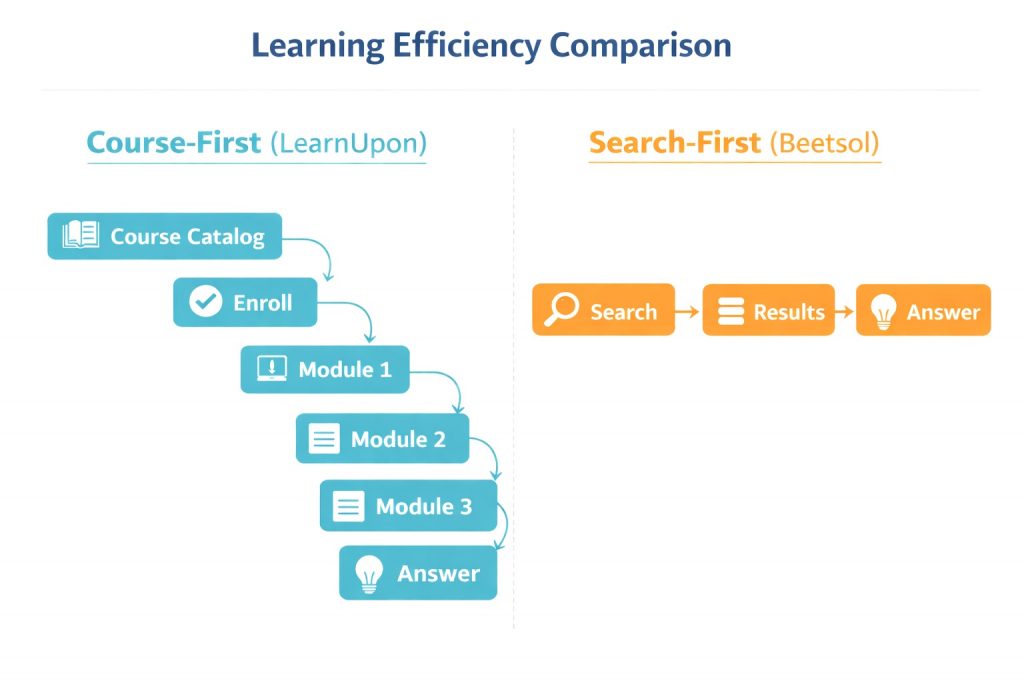
Content exists as atomic, searchable modules — not trapped inside sequential courses. When structured learning is needed (onboarding paths, certification programs), those same modules assemble into courses without content duplication. The difference is activation speed: days vs weeks, and adoption: 60-80% vs 25%.
Semantic Search That Understands Intent
Beetsol uses vector embeddings (pgvector) to understand the meaning behind customer questions. When a customer searches “how do I let someone else access my account,” they find “User Permissions,” “Invite Team Members,” and “Delegate Access” — conceptually related content regardless of terminology. Learn more about how Deep Search works →
Embedded Learning Without Context-Switching
Beetsol embeds directly into your product, help center, or support workflows — no separate portal, no different login. The context-switching problem disappears entirely.
Implementation in Days
Upload existing content (videos, PDFs, docs, SCORM — any format) on Day 1. AI auto-indexes everything. Configure search and branding on Day 2. Test and launch on Day 3. No course structuring. No portal configuration marathon.
Pricing
- Starter: $6,500/year (up to 100 active learners)
- Growth: $15,500/year (up to 250 active learners)
- Scale: $27,000/year (up to 500 active learners)
“Active learners” = An active learner is anyone who logs in or searches in a calendar month, counted once no matter how often they return. Each plan includes a set number of active learners, provisioning is unlimited and free, and anyone above your plan is billed at a flat $7 per active learner per month.
Every Beetsol feature is included at every tier — semantic search, content gap detection, embedded learning, analytics — all available on Starter. The tiers differ only in active learner count. No paying for idle seats. No capability gating. No add-ons. See the ROI Calculator →
What Beetsol Doesn’t Do (And Why That’s Good)
No multi-portal management (specialized for customer training, not multi-audience). No gamification (voluntary learners need findability, not points). No learning commerce (if you’re selling courses, use Thought Industries). These aren’t gaps — they’re focus.
Migrating from LearnUpon: What to Expect
Phase 1: Audit and Export (Days 1-3)
- Identify which portals are actually used (customers? employees? both?).
- Export customer-facing training content (videos, documents, SCORM).
- Determine if employee/partner training stays on LearnUpon or moves separately.
Key question: Are all LearnUpon portals seeing real engagement, or is customer training doing the heavy lifting while employee and partner portals sit mostly empty? If so, keep LearnUpon for the audiences that use it and add Beetsol for customer training.
Phase 2: Setup and Migration (Days 3-5)
- Upload customer training content to Beetsol (all formats supported, no restructuring).
- AI auto-indexes and makes content semantically searchable.
- Integrate with CRM, product; configure SSO.
- Embed training widget in product or help center.
Phase 3: Pilot and Rollout (Week 2)
- Run pilot with 15-20 customers from different segments.
- Measure: search success rate, time-to-answer, content gaps surfaced.
- Full customer rollout once pilot confirms improvement.
Total timeline: 2 weeks for customer training migration.
Common Objections to Switching
“LearnUpon is simpler than enterprise LMS — isn’t that enough?”
Simpler than Docebo, yes. But still course-first. The architecture is the issue, not the complexity level. A cleaner course catalog is still a course catalog. If your customers aren’t enrolling in courses to find answers, a simpler course platform doesn’t solve the problem — it makes the problem more aesthetically pleasing.
“We use multiple portals. We’d lose that.”
If all portals see real engagement, keep LearnUpon for the audiences that need structured courses (employees, partners) and add Beetsol for customer training. Each platform does what it was designed for. If the customer portal carries most of the load and other portals sit underused, you’re paying for multi-audience infrastructure you don’t need.
“Our customers are used to the current academy.”
If your current academy has 25% adoption, 75% of your customers aren’t “used to” anything — they’re not using it. The gain from reaching the 75% who currently don’t engage far outweighs the transition cost for the 25% who do.
FAQ
Can Beetsol replace LearnUpon completely?
For customer training: yes. For multi-audience training across employees, customers, and partners: no. If you genuinely need separate portals for different audiences with structured course delivery, LearnUpon serves that use case well. Many companies keep LearnUpon for employees/partners and add Beetsol for customer training.
Do we lose course structure entirely?
No. Beetsol supports courses and structured learning paths. The difference: customers aren’t forced into courses to access information. They can search and find specific answers OR follow structured paths. Both work with the same content.
What happens to existing LearnUpon content?
All content migrates: videos, PDFs, SCORM files, presentations, documents. Beetsol auto-indexes and makes it searchable. No reformatting required. Course structures and gamification data don’t migrate, but in a search-first platform, courses are optional overlays rather than mandatory containers.
Next Steps
If LearnUpon was the right tool for multi-audience training but customer training has become your primary mandate, the question is whether a cleaner course platform is enough — or whether your customers need a different architecture entirely. Start by asking: what percentage of our training users are customers vs employees, and what’s our customer training adoption rate?
For comprehensive guidance on building effective customer training programs, see our customer training LMS strategy guide.
Then run a 30-day side-by-side pilot:
- Request a Beetsol pilot with your actual customer training content
- Run it alongside LearnUpon with real customers
- Track identical metrics for both: time-to-answer, content utilization, support tickets, activation speed
- Choose based on data, not feature counts or vendor promises
Most companies discover that multi-portal management looks good on procurement checklists but specialized architecture delivers better real-world customer outcomes. A 30-day pilot removes the guesswork entirely.
See how Beetsol’s Customer Training Architecture works →